Friday, July 31, 2009

Looking to tomorrow

Fingers crossed I guess
I commented last month that the new venue for Claymore has revived my interest in this venerable event on the Scottish gaming calendar, which I've attended in recent years mostly for the sake of nostalgia and the chance to catch up with my old Edinburgh buddies. I'm not quite sure what I'm expecting, since there is no sign that there are any radical departures in the programme; eg. there is still no open gaming space laid on, as is the norm at boardgaming conventions and which is commonplace across America AFAIK.

I could turn this post into a rant about the oddity that so many gamers seem to find nothing strange in conventions the primary purpose of which is not to enable them to indulge their primary hobby passion, ie. actually playing games. But no, instead I'll just get on with making what I can of the Claymore 2009 programme.

Claymore Painting Demo
I talked about "radical new departures" above because for all know the Claymore Painting Demo is new. Whatever, I'm in the process of getting back into the miniatures hobby, and tips and techniques from other painters are always welcome. So I expect I'll be spending some time at this table.

Games at Claymore
Looking at the list of Games at Claymore, and stripping out the display games (I'm looking for something to play, remember?) leaves the following:

  • Angus Wargames Club - “Free the Hostages” 28mm.
  • Bathgate Wargames Club - Pyramid 28mm.
  • Blues Bears 1/600 air.
  • Dingwall Wargames Club - Dambusters 1/144.
  • Dundee Skirmishers - WW2 Skirmish.
  • Edinburgh League of Wargamers - TBA.
  • Livingston Battleground.
  • Mythgardia.
  • Phoenix Wargames Club - Ancient 28mm.
  • Royal Air Force Wargamers Association (Leuchars) - “Bloody Omaha” 28mm.
  • Urban Mammoth - Metropolis Sci-fi 28mm.
Looking at that list I made 2 immediate choices:
  • DWC's dambusters game.
  • Dundee's WW2 skirmishers game.
Both these choices are pure sentiment: my dad went to school in Dingwall; and I grew up in Dundee, as regular readers might remember. Still, on the face of it they look like they should be good public participation games. The dambusters game in particular looks tailor-made for the sort of quick-and-dirty knockabout fun that makes for a lively gaming table with lots of entertained gamers passing through.

Assuming I have the time or the inclination to play something else, my first choice will be the RAF's "Bloody Omaha". This is for the simple reason that my return to miniatures gaming is inevitably going to bring me back the WW2 roots of my teenage tankie days. So I'd be interested to see another WW2 game in action, perhaps with a completely different set of rules.

Writing all this up has brought to mind a happier memory amid the carping, one dating from a Claymore of old back in the 80's, when the venue was the long gone Chambers St. Students' Union. I found myself watching a participation game (I couldn't join in because it was full), and got chatting to the organiser. Discovering that his game was a homebrew (there were far, far fewer sets of WW2 rules for any scale available back then), I asked the guy about his rules, deeply engaged as I was back then on working on my own set of WW2 microarmour rules.

One rule particularly impressed me, a rule the guy called 'To Move Under Fire'. Simply put: each man had a dice roll to make if they were going to be allowed to move while they were being shot at (don't ask me about how the timing of this was handled because I can't remember). When I say this rule "particularly impressed me" I understate a bit: the rule had the effect of a bolt from the blue. Never before had those little lead men seemed so alive as they did that afternoon.

Many different wargames and rulesets have influenced my thinking about WW2 tabletopping down the years, positively or negatively. Three of the most noteworthy are: These games are all justifiably famous and their influence runs wide and deep, across and through the hobby and the industry, as well as for yours truly. But in his way, that anonymous grognard had as much influence as all the rest because of the sheer intensity of that blinding flash of insight his little rule occasioned. So like I said above: fingers crossed I guess. ;)

Thursday, July 30, 2009

A low and dirty business

Andy, Donald and Gav were round for games on Sunday. I'd asked for requests and Gav had suggested Risk or History of the World. I played HotW for the first time last April and am certainly keen to play it again, but on Sunday still laboured under the lassitude of the same vicissitudes which had occasioned Badger's and my recourse to Ivanhoe on Friday, instead of the habitual Combat Commander. So I plumped for Risk and a consensus in favour soon followed.

Risk
Celebrating its 50th birthday this year, Risk is a hardened veteran par excellence of modern gaming and is surely the closest thing to a board wargame most casual family gamers will experience. It's certainly the first game of its ilk I ever played: we got the edition with the cylinders and triangular prisms for playing pieces for xmas when I was 10 or 11. In our first game that xmas day I was well on my way to victory- I'd secured Australasia and Asia, and had just captured Europe; when we had to clear the table for dinner. Were Napoleon's world-dominating designs ever similarly foiled I wonder?

My current copy of Risk is the modern edition which includes the little Napoleonic period models, and the Mission cards. Risk has been very well served by this new edition. The key changes to the game I remember from the 70's are:

  • The Mission cards give each player specific geopolitical objectives instead of them all sharing the same objective, which was simply to take over the entire world (this is still a variant in the Advanced Rules).
  • Setup is easier because the initial phase is determined by the deal of the Risk cards.
Between them, these 2 changes provide for a game that can easily be played to a conclusion in a couple of hours, which means that it's more likely to see action on the table. This I like.

What went down
Sunday's game saw me lumbered with the Mission to conquer Asia and Africa and a setup which saw me start with a mere 3 territories- all in Asia, in my objective continents. I used the buidup to reinforce my positions in Europe and South America, which were to be the jumping off points for my attacks on my objectives.

Donald delievered the first blow to my plans when he attacked and conquered Brazil, where I'd stationed my initial African expeditionary force. IIRC I was never able to mount a serious attack on Africa for the rest of the game. Elsewhere Donald and I spent a long time fighting back and forth across central Asia as I tried to stabilise my holdings there towards meeting my Mission objectives. My European armies just sat around doing nothing in particular until they were squeezed between other powers.

With my plans coming to naught and my visions of global domination fading fast, I was holding on grimly in the hope of an upturn in my fortunes. I was eventually put out of my misery by Donald. In one of those turns which will be familiar to fans of Risk, his armies swept across the board until, with a final dice roll of 2(!) he'd conquered the 24 territories which we already knew were his Mission objective. The final positions were:
  • Andy: 3 (18 territories w/2 armies in each).
  • Donald: 24.
  • Gav: 8 (Conquer N. American and Africa).
  • Me: 7 (Conquer Africa and Asia).
Donald was especially pleased at his victory: he'd not played Risk in decades, and had never won either.

Score
The 'Old Man' 1
The young Turks 0

Afterthoughts
Grognards and other hardcore adventure gamers use all sorts of metaphors to encapsulate their enjoyment of the simplicities of Risk as opposed to the complexities of other games. On Sunday, I was happy to play as a bit of light relief. I enjoyed the game a lot and look forward to playing it again sooner rather than later. Risk is a classic for the simple reason that it's a very good game.

As already noted, I like the effect of the Mission cards. As well as shortening the playing time, they also open up more diplomacy, because judging your opponents' missions by their actions becomes an important part of the game. On Sunday Gav soon tidied up Australasia, whereupon I announced that he might be going for the Australasia and North America mission. Gav demurred, noting that he might equally just be exploiting a local advantage.

More than that: after I'd mistakenly singled him out as the Cylon in our last Sunday session's game of Battlestar Galactica, Gav suggested that he was the victim of some kind of personal vendetta. He was wrong of course; he was just the victim of my mistakes! Still, I liked the way that the mission cards opened up new layers of strategy and accompanying tabletalk which I don't remember from the games of my youth.

War on Terror
Denounced sight unseen before its publication by Tory MP Andrew Lansley as "in very bad taste... as though somebody has gone too far"; and seized by police because the balaclava the game includes "could be used to conceal someone's identity or could be used in the course of a criminal act"; War on Terror is a game satirising 21st century geopolitics. It is one of the games I picked up at UK Games Expo'09.

Personal apology
Regular readers who remember my fondness for the great grandaddy of satirical adventure games- Nuclear War, might wonder why it has taken me nearly 3 years to get my hands on the most up-to-date addition to this noble gaming tradition. I have no satisfactory answer to this question. I guess I'll just have to promise to do better next time.

Official disclaimer
Before going on to to look more closely at the game, I feel compelled to make this disclaimer:
War on Terror: the boardgame is a boardgame satirising 21st century geopolitics. It does not attempt to be a simulation of its subject, and as such bears the same relation to the actual ongoing War on Terror as do the comedy stylings of any edgy standup comedian; that is to say: tangential at best.
Thank you for your attention dear readers, I can now return you to your scheduled article.

In the box
For those of my readers who've never seen WoT, the game can aptly be described as a mashup of Risk and Settlers of Catan, with dashes of Nuclear War and Apocalypse: the Game of Nuclear Devestation thrown in for good measure. So there is a map on which all the continents of the world are broken down into countries over which the players - the Empires - will fight the good fight while garnering themselves their own little bloc of oil-rich real estate. The oil is represented by oil tokens randomly distributed across the map; these have numbers which generate oil wealth as do the tokens in Settlers, except that the currency of WoT is cold hard cash.

The playing pieces are colourful (and durable) plastic tokens of 3 kinds; 7 sets, one for each of up to 6 players, and another for the terrorists (in black). These represent (in increasing power in game terms):
  • For the Empires:
  1. Villages.
  2. Towns.
  3. Cities.
  • For the terrorists:
  1. Vanguards.
  2. Columns.
  3. Cells.
In addition there are:
  • 2 sets of action cards- Empire and Terrorist cards, which are the core of the players' actions and finkery (well, there just had to be finkery, didn't there?).
  • 3 dice:
  1. 1 Action dice, which determines the players' development opportunities each turn.
  2. 2d6 to generate those ever-precious oil revenues.
  • Cash (Settlers' resources work very nicely, but yer actual filthy lucre is always fun).
  • A pad and pencil for sending secret messages.
  • Handy reference cards for each player.
  • And the already legendary 'Evil' Balaclava which Kent police found so threatening nearly a year ago.
Most of these parts are very nicely produced. That "most" is because the Empire and Terrorist cards are a bit flimsy; and the Action dice isn't engraved, so that it had started to wear even during our first play of the game. Those complaints nothwithstanding, this box of stuff represents good value for your £29.95 (perhaps those Kent coppers recognised a good bargain when they saw one?).

On to the game
So WoT finally appeared on the table last Sunday. I'd skimmed the rules, although I can't claim thoroughly to have read them let alone studied them. Nor had I set the game up the better to familiarise myself with its workings. I think therefore WoT deserves good marks for conceptual simplicity and clarity of rules exposition because the 4 of us were able to get our game up and running with the minimum of fuss.

The aim of the game in WoT is to secure a certain number of Liberation Points. Liberation Points are awarded as follows:
  • Empires:
  1. For control of each continent (similar to Risk, but VP and not extra armies).
  2. For each city.
  • Terrorists (yes, players can turn terrorist- more below):
  1. For each continent free of Empire developments.
The LP required for victory depends on the number of Empire players in play. This is a neat twist because it makes the game easier to win for all sides the more players have turned terrorist.

The basic rules of play are admirably straightforward. Each turn comprises the following steps:
  • Roll the Action dice to see how many developments you'll be allowed that turn: ie. how many villages to build or villages/towns to upgrade.
  • Take your allocation of Empire and/or Terrorist cards: usually 2 of the former, but this can vary.
  • Play your turn: buying and selling developments and/or cards; playing cards to wage war, make terrorist attacks and other stuff; bribing and cajoling other players; cackling with manic glee; and so on.
  • Roll the 2d6 to see who gets oil revenue that turn.
This simple turn structure meant that we got our gaming rolling every bit as quickly as we'd set it up. The Empire cards allow for all sorts of dirty tricks and soon we were expanding our oil empires- erm, negotiating trade agreements; launching terrorist attacks- supporting freedom fighters against brutal dictators; fomenting terrorist infighting; and waging war on recalcitrant terrorists with gusto.

Another already infamous feature of WoT is the Axis of Evil: the spinner used every so often to single out one player as the Evil Empire. After a few duff spins (ie. colours not in play were selected), Andy finally enjoyed the honour of being our first Evil Empire. We just had to mark the occasion with a photo. As the game progressed we all enjoyed our turn as the Evil Empire, and so...

The Brotherhood of Evil

And when I say "enjoy" I mean it: one of the perks of being the Evil Empire is that you get 2 free Terrorist cards as well as the normal 2 Empire cards; and these cards are the driving force behind all the fun in WoT.

Another source of much entertainment in WoT is the peculiar dynamic of the terrorist pieces:
  • They are the primary means of attacking your opponents' developments (villages, etc).
  • They are cheaper investments than development, although they deliver no income.
  • But (and here is where the real fun begins), any player can use them once they are on the board.
This means that the terrorists in WoT are a double-edged sword at best; and your nemesis at worst.

The terrorists provide another entertaining twist in WoT (nah, who'd've thunk it, I hear you cry): players can 'Turn Terrorist'. This can be forced on you by circumstances- ie. bankruptcy or losing all your developments; or you can choose the option at any time. Terrorist players play as a team, sharing one turn, and no doubt falling out with each other as regularly as their schismatic realworld counterparts.

As if all the foregoing horrors weren't enough, there is the nuclear option. This is provided by Empire cards (the Terrorist deck provides WMD's: less devestating but still powerful). I deployed the first pair of nukes in our game on Sunday, wiping out at a stroke the extensive developments in Africa and Latin America which'd put Andy within a single good turn of victory.

What went down
We all had our turn at the Evil Empire. Andy got a double first when I hit him with those nukes. The game ebbed and flowed for quite some time as we found out that it's much easier for the terrorists to take your developments down than it is to build them back up again. Eventually, reduced to a mere 3 countries, and just plain curious, Donald decided to turn terrorist.

Later I noticed something that had come up before: that if I got my move right and then turned terrorist, I could declare a terrorist victory. I'd offered this deal to Andy earlier, only for Donald and Gav to announce that they'd immediately do the same so that we'd all win. My offer was promptly withdrawn. This time I just made the move and declared the victory, leaving the others to... to, well what exactly? Squabble over who had the next biggest share in the victory? I'm not really sure, but I think we all found the outcome strangely fitting.

Score
Evil Donald 1 and a bit
Heroic liberator me Another bit (plus the moral high ground?)
Evil empires A bit each? Nothing?
:-/

Afterthoughts
I had mixed feelings about this game as we were playing it. It is fast and fun to play, but I was left for a long time with the feeling that it was a game which had some good ideas that were insufficiently developed. I said even as I voiced those feelings that I knew a single play was too early to be sure of such a judgement, an opinion of which I am more sure now than ever.

Those thoughts were based on seeing how dynamic the game can be, now easy it is to knock players down. This left me wondering if WoT might not be one of those games you wouldn't play that often because it just takes too long to play.

It was Gav who first suggested that there were depths to the gameplay requiring strategies which were opaque to us. He later added that he reckoned that one of us should've turned terrorist much sooner. Whether or not he's right about the latter, I'm sufficiently persuaded about the former to have WoT high on my list of 'must plays'. And that even if it does turn out to be just one of those long games, ideal for a Sunday afternoon, say. ;)

Tuesday, July 28, 2009

Curse you you varlet!

The recent gaming drought ended with a visit from Badger on Friday. I remained under the cloud of those recent vicissitudes, so we ended up playing a few rounds of Knizia's everfresh cardplay gem Ivanhoe. Everfresh? Clunky neologism? Quite possibly. A touch hyperbolic? Not at all.

I've recorded 68 games of Ivanhoe since I started reguarly recording my games played @BGG back in 2007. This filler from 2005 reminds me that I've owned the game for some 7 years now, so that even just 1 game/month in the forgotten years would add about 50 more games to the total. Ivanhoe thus merits its place in the 2nd division of my most played games ever: games which I've played some 100 or more times (that's games #6 to #10 below BTW).

My 'most played' and 'must play' lists, courtesy of BGG

(Badger and the lads might want to note the Hot 10 which accompanies this Top 10: I'm hoping they'll be seeing these games across the tabletop in the immediate weeks to come!)

Accounting for taste then: to be 'everfresh', a game will display some subset of a finite list of attributes around the positive merits of which can form a durable consenus. Ease of learning, speed of teaching and playability are all obvious metrics for these attributes, but it must be remembered that these are all modulated through their interrelationship with games' expression of their themes, according to the desired degree of resolution (AKA level of abstraction). That is to say: those abiding attributes are less the 3 obvious metrics themselves than they are the systemic features of games' architecture whose forms underly those metrics, thematic expression, and any other appropriate categories.

Anyone who knows Ivanhoe can vouch for its scoring high in the learning/teaching/playability metrics. Regular readers probably won't be won't be surprised that the game's cardplay is the core of what makes an everfresh game out of numerically high LTP metrics as against an equivalently low score in thematic expression. But even the oldest of old hands might be wondering how this statement of the bleeding obvious in any way justifies my high-faluting wordage.

What I'm on about here is cardplay as:
  • Games' architecture that delivers players neatly and vividly into a particular viewpoint (I have already discussed this in relation to Up Front- here; and Memoir'44- here and then here).
  • A specific gaming skillset.
The players' immediate viewpoint in Ivanhoe is obvious enough. However the abstraction away from concrete space created because Ivanhoe is a pure cardgame is not the simple spatial remove of Up Front and Memoir'44; rather it is a temporal, as per the game's premise- a game of non-lethal tournaments instead of the mortal combat more familiar to wargamers. The following elements then are among those Reiner Knizia packaged together so nicely in Ivanhoe:
  • A precisely focussed card-driven viewpoint: 1 person.
  • A non-lethal theme that implicitly connects all the games after the fashion of rpg's.
  • An abstract representation of space, time and movement which drives that implicit connection towards explicitness because its abstractness foregrounds the temporal.
  • A cardplay skillset whose crucial subskills - eg. deck knowledge and hand building - neatly reflect the learning curves of the game's viewpoint protagonists (cf. the M44 posts above, the 2nd especially).
I hope by now readers will begin to see why I think that Ivanhoe is proving to be an everfresh game: its simple system architecture supports a thematic model which belies its simplicity. The key to this is the repeated play which unlocks the specific features of the thematic model. If that seems to amount to the circular argument that Ivanhoe is everfresh because it's everfresh, I plead guilty. I guess that's the ever-present paradox of generalising from personal taste.

What went down
Badger and I played 6 games. Unlike a long ago session, any ownage was all on Badger's side: a single game fortunately. The other 5 games went to the wire IIRC. In the end, Badger proved that he's a much better Ivanhoe player than he was those 4 years ago. All that practice at M44 and CC has stood him in good stead it seems.

Score
Seasoned squire 4
Creaking chevalier 2
:-(
;)

Wednesday, July 22, 2009

Snippet snackage

I've not played any games for nearly three weeks and, vicissitudes having abounded, I'm reduced to a rummage through the ragbag in search of a posting.

Expo rolls!
Hot on the heels of the success of Expo'09, UK Games Expo a couple of weeks ago announced dates for 2010, 2011 and 2012 (the last two still TBC). Organising an event on the scale of UK Games Expo must be something of a mammoth undertaking and an often thankless task, so it's an encouraging sign for the long-term future of the event that the organisers are already looking ahead into the next decade of this 21st century.

After the success of CC@Expo'09, you can be sure that I've already set aside the long weekend of the 4th to the 6th of June 2010. More in due course, naturally enough.

View from a Hill?
Even more 'old news' than that about Expo'10 is the story that John Hill has joined the design team at Academy Games, publisher of the very successful and utterly intriguing Conflict of Heroes. The designer of the seminal WW2 tacsim Squad Leader, John Hill is still quite simply the biggest name in the field. Getting him aboard to work on Conflict of Heroes is quite a coup for Uwe Eikert and his crew at Academy Games. Grognards have to expect that this will bode well for the future of CoH after the release of Storm of Steel, the imminent sequel to Awakening the Bear.

And that, for today, is that. Normal service will be resumed as soon as possible. ;)

Monday, July 13, 2009

Here's another I prepared earlier...

A quick introduction
Regular readers might remember that I posted, last December, my long-delayed recantation on the topic of roleplaying as art. This here post has nothing to do with roleplaying (in the sense of tabletop rpg's, just in case there are those among you who immediately think that there is an element of roleplaying in costumed historical re-enactment); it's just that it too has been sitting on the rack for a couple of years.

So, why post it now? Or, to put it another way, why not post it then? On the latter point, there were 2 reasons I can recall:

  • I had (and still have to some degree) mixed feelings about using my blog as a platform to intervene in actual ongoing discussions from afar, ie. when I'm not joining in at source. "But that's exactly what blogs are for, dummy!" I hear you cry, dear readers. Well, you live and learn, eh?
  • I felt the article was too political for RD/KA!.
The main reason why I chose to post it now was simple enough: I needed some material because I'll be unable to attend to the blog this week. I daresay the Euroelection results also made the topic seem sadly all too pertinent. This all the more so since, not long after the furore over the SBG at Salute, a BBC reporter went to a militaria fair. And what did he discover? Yes, you've guessed it dear readers, the SBG's ranks were replete with neo-nazi ultra-reactionaries.

NB. As with the article on roleplaying and art, there are some temporal references which are well out of date. Again I'm just leaving them as they were first written.

Dubious bedfellows: the 2nd Battle Group

You might remember a few weeks ago when I said that I didn't believe the execrable 300 to be "some kind of crypto-fascistic parable." (Here's someone who thought otherwise by the way; via Ken MacLeod's The Early Days of a Better Nation.) I also said at the time that the "charge that art might celebrate fascistic impulses is... very serious..." Which is why I felt that I just had to comment on the furore which has raged all week over at The Miniatures Page - a hub of the miniature wargamers' ecommunity.

The subject which generated so much invective in nearly 500 posts over 3 threads (first report on the event; Salute organisers offer their apologies; Salute organiser resigns) was the appearance at Salute 2007- Britain's leading independent wargames convention- of the Second Battle Group, a WW2 re-enactment group who choose to represent the 1 SS Panzer Division Leibstandarte SS Adolf Hitler, ie. Hitler's elite bodyguard.

Without going into too much detail, I can summarise the overwhelmingly negative response something like this:
  • The choice of the SS was offensive because of what they represent, but it might've been better if some Allied units were represented too, for the sake of balance.
  • Even if you can accept the validity of representing an SS unit, dressing your kids up as Hitler Youth was a step too far.
  • And selling Hitler mugs and Nazi flags (a.k.a. "novelty items" in the words of one 'astute' TMP poster) was just beyond crass.
  • Battle re-enactors are a bit weird too, aren't they?-: so SS re-enactors must be outright freaks.
  • Above all, this was a terrible image to present to the world of the wargaming hobby at a major event which was right in the public eye.
The dogged and vocal minority opinion can similarly be summed-up something like this:
  • Stop whining you wusses!
  • PC's gone mad, I tell you, mad!
  • The Nazi's might've been bad, but war is hell, and anyway, Stalin's Russia and Mao's China were worse (which is true actually).
  • Why is it wrong to dress up as the SS if it's not wrong to sell books and models featuring them- which, as we all know, are very popular in WW2 wargaming circles?
Now please don't be misled by my flippant tone. I don't for one minute think that the morality of war toys and militaristic hobbyism is a trivial matter. In fact it is a subject I have puzzled over for many years. My parents' qualms about my brother and I having war toys aside, the issue raised its head for me personally over 30 years ago.

Like many of my generation, my entry into what eventually became my gaming hobby was through making Airfix kits. After a few years throwing together the familiar aeroplanes I discovered tanks, and I was hooked. Tamiya kits quickly followed, and soon I was enough of a hardcore teenage tankie to have a regular order for the Military Modelling magazine at my local newsagents. Oh happy days!

If my memory doesn't fail me, this was at about the time that the first political campaigns were being waged against war toys. One day, I read that toy guns had been banned in Sweden. The case was that playing with war toys contributed to the militaristic culture which was then widely discredited because of the carnage of the Vietnam War. In my youthful innocence I thought that this was frankly bizarre. Surely- I thought- we had war toys because of war, and not vice versa?

Sometime thereabouts I read- in the pages of my Military Modelling I seem to recall- the strange story of how Airfix had to hire women to sit down with scissors and snip the swastikas out of their WW2 German Luftwaffe airplane kits' transfer sheets so that they could be exported to Germany, where the depiction of swastikas was illegal. This too I found odd. The obvious issue of a historically authentic representation came to mind; but more than that, I couldn't help but find something funny at the idea of genuine German neo-Nazis saluting a tiny 5mm swastika clipped from the transfer sheet of a 1/72nd scale model of an Me109.

Strangely enough, this issue resurfaced many years later. I was sitting in a pub one night when I overheard an interesting conversation nearby. Glasgow pubs being what they are, I invited myself into the company: an aging local, and a young German visitor. At last!- I thought, my chance to ask someone about the peculiar issue of the Airfix transfer-snippers which had so perplexed me 2 decades previously. Unfortunately the young German's English was poor, while my German was worse: being the useful conversation-stoppers you learn from a youthful diet of British war comics. This communication left the young German uncertain as to the drift of my questions, so that I left with my curiosity unsatisfied.

All of which brings us back to Salute, the SBG, and a certain disingenuosness on both the SBG's part and that of the 'stop whinging' minority over at TMP. I mean to say: it's not as if they don't have a case. After all, the only 'clean' armies in history would be those which never saw action, and, if such a beast can be found, it's hardly going to interest those whose hobby is centred on a fascination for warfare- real or imagined, past, present or future. So if we accept that one side in any given war can be represented, in whichever media people prefer, then we have to accept that any and all other sides must also be represented- clear historical perspective at the very least requires this, surely?

And the dressing up? Well it's not for me, but let's be honest here: is dressing up really that much more weird than playing with toy soldiers or pretending to be an elf, or what-have-you? Or is dressing up only acceptable at parties, or when someone else has written your lines?

This is all very well, but it's an abstract defence of people's right to 'do history' in any way they see fit. Where the SBG, and the minority over at the TMP were being a bit disingenuous is that the matter of depictions of the SS is not just a matter of history. And I'm not here talking about the feelings of the survivors of the Nazis' genocidal rampages, however pertinent those feelings are. What I'm talking about is the present and future fact of the growing electoral presence of neo-Nazi parties in Europe, parties for whom the SS are symbols of martial prowess, however strenuously this is denied.

And there's the rub for the SBG it seems to me. Let them have their costumed historical reconstructions. I mean, if a famous movie director lavished a vast budget on doing exactly the same, Golden Globes, BAFTA's and Oscars might well be on the cards. But selling Hitler mugs and Nazi flags as souvenirs? What's that got to do with historical re-enactment? Hmm?

Friday, July 10, 2009

New Timeframes?

Sunday gaming was cancelled a couple of weeks ago due to an impromptu daytrip to Dundee, my old home town. The visit was occasioned by my discovery, from his twitterfeed, that Warren Ellis was due to appear as a headline speaker in Timeframes, the comics programme of the Literary Dundee festival (as fB friends and tweetfellows might remember). Warren Ellis' Wildstorm superhero series The Authority was instrumental in reviving my interest in contemporary comics after a layoff during the 90's, and I set off thereafter on the familiar completist's quest: to get my hands on as much of his work as possible.

Alan Grant's name in the programme was just the icing on the cake. Grant wrote many of the seminal comic stories of my youth, Judge Dredd being the best known. On top of that, I'd bumped into Alan Grant once in a comics store in the old Dens Road Market in Dundee back in the early 90's. He proved to be genial, interesting and generous.

The journey to Dundee was uneventful, although finding the venue for the event wasn't quite so straightforward. I grew up in Dundee as I said, and my dad was a university lecturer, so the area in which the event's venue was located was quite familiar; or, at least, it used to be. As I doubled back in search of what, inevitably enough, turned out to be the first likely looking building I'd seen, I was amazed at how much the area had changed in the past decade: new buildings were everywhere; none of which had anything in particular to recommend them.

I arrived late. At this remove from the event it is impossible for me to give more than capsule impressions of the talks I sat through.
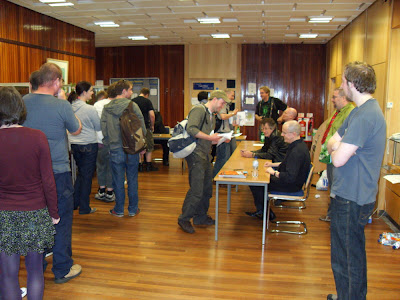
The throng of fans descends upon the stars!

The programme
The first programme item I attended - under the 'British Science Fiction Comics' heading - was Bill McLoughlin and Keith Robson's talk about DC Thomson's Starblazer, a comic of which I was only vaguely aware during its 1980's heyday, and which I never read. The pair weren't the best speakers but their subject was interesting and they came to life when, their individual contributions done, they began to bat the topic back and forth. An interesting snippet was how many of the writers and artists who went on to enjoy fame on both sides of the Atlantic in the 80's and 90's began their careers on Starblazer. There was an open hint of resentment on the part of McLoughlin and Robson at how little this has been acknowledged.

There followed Peter Hughes Jachimiak's lecture:
' Days of Future Passed' [sic]: 1970s Britain, Economic Downturn and Utopian Futures in Children's Science Fiction Comics.
The academic styling of this title was matched by the tone and poor delivery of the speaker. It was a real shame that Jachimiak apparently can't tell the difference between being scholarly and being academic because his subject was fascinating, and one that I hold close to my own heart (cf. eg. 'A Parcel of Rogues' - tangential I'll admit, but germane I'll avow). All I can here add is that Jachimiak at least succeeded in awakening in me an interest in the literature of comics' studies.

Jachimiak's lecture left me with no appetite for another taste of comics being drained dry of their abiding thrills by the inappropriate register of the academic text. This was a bit of a shame really, because the subsequent item sounded promising:
David Bishop, 'Time Twisted': A look at Alan Moore's treatment of time frames in 2000AD.
In any event, I don't know how Bishop's session went, because I spent it in a nearby pub.

Alan Grant signs my Batman/Judge Dredd: Vendetta in Gotham graphic novel

Keynote #1: Alan Grant
I returned in time to hang around awaiting the first keynote presentation of the day, by Alan Grant. Billed as 'My Adventures in Comics', Grant began by announcing that the intellectual standard of the preceding lectures had led him to rethink. And so we were treated to a cogent and highly stimulating cri de coeur appealing for story, a case made by the grandfather of 4 young children (11 years and under) who also just happens to be equipped with the insights of a lifetime's writing in comics and multimedia.

It is obviously impossible to give more than the briefest of hints of the themes of Grant's half hour talk, especially at a week and a half's remove. The best I can hope to do is to pick out a few of his key themes:
  • Grant's central bete noire was the role of corporate marketing and branding in reducing stories to bland, conflict-free narratives where they're not removed altogether (ie. in puzzle/activity books).
  • Thus we find that young readers aren't being exposed to essential features of the role of story in character building; that is to say, narratives dramatising:
  1. Morality.
  2. Hope.
  3. Rebellion, and the irresistable lure of the ever-necessary challenge to authority.
  • The consequence of all this Grant argued is that we are seeing a young generation grow up who lack the frames of reference that'd enable them to avoid being swept along with what Grant called the 'Platonic stories' of the powers that be; eg. the drive to war in Iraq in 2003, to note just one example cited by Grant.
There was a lot more to the talk than this, naturally enough, but that's the gist of the key themes. I have to say I didn't agree completely with all of Grant's points; but he was never less than interesting. I'd really like to hear more of what he has to say on this subject.

Warren Ellis with my copy of Planetary, Vol. 1: All Over the World and Other Stories

Keynote #2: Warren Ellis
Warren Ellis' style stood in sharp contrast to Alan Grant's, beginning as a rat-a-tat-tat of aperçus and anecdotes drawn from what is obviously a wealth of material, and woven together with biting wit into a whole which became increasingly greater than the sum of its parts as the talk gathered momentum. The naturally meandering style of the born raconteur meant that there was less of a definite theme to grab hold of in Ellis' talk than there had been in Grant's. So I really can't comment all that much on what Ellis said, other than to note that it was never dull, often provocative, and well worth the price of entry. I'd be keen to hear him talk again.

Elsewhere
No comics event featuring star writers and artists would be complete without signings, which duly took place. I also made an effort to talk to other people there. I particularly enjoyed meeting some young GW fans, with whom I shared a pleasant chat about all things Warhammer- 40K especially, naturally enough.

Who's watching who? The official photographer and I share a wee jape

Final thoughts
Timeframes was the 2nd comics programme to feature at Literary Dundee. My caveats notwithstanding I enjoyed a stimulating day out; my complaint wasn't so much the scholarly approach to understanding the place of comics in culture as it was the overly academic way in which this scholarship was put across. In any event, I was pleased to be in such an intellectually challenging environment, and hope to be able to return next year. A palpable hit then, I guess. ;)

Wednesday, July 08, 2009

Games a gogo!

The vicissitudes of everyday life have taken their toll on my blogging- key amongst which has been my labours to get my painting table up and running again after my long layoff; and a future onslaught is already on the horizon. Meanwhile, here is a quick roundup of last weekend's gaming.

Combat Commander
Badger was due round for another dose of Combat Commander last Friday. He was expecting us to continue our Stalingrad campaign. What he didn't know was that Mark and Robert were due to visit again. Hoping therefore that he might get chance to taste revenge after the pastings he'd suffered at Mark's hands last mayday, I suggested to Badger that we play an official scenario, something we could set up and play more quickly than the campaign with its decision tree and record keeping.

CC:P Scenario #B: Ambush at Mogaung
Learning that I had trimmed the corners of all my CC:P counters in readiness for CC@UK Expo'09 (what did he expect, hmm?), Badger decided that he wanted to try out another PTO scenario. Continuing from where we'd left off, as you do, we found ourselves in Burma (linkage to a nifty BBC animated map showing the course of the whole campaign) in June 1944.

The operational area; & its place (inset) in the '44-45 Burma campaign

The scenario represents an impromptu ambush by weary Chindits on a similarly ragtag Japanese column; and features an unusual variation on preplotted setup, in which the Commonwealth player has a range of predesignated setup hexes, plus some whose location can be chosen. The kicker is that these last must be chosen before the Japanese player sets up. The overall effect is similar to that of Scenario #20, A March in December.

Random selection gave me the Japanese. My dispositions gave me a plan with 3 elements:
  • A weak northern force (NB. north isn't conventional on the scenario map) which I was essentially willing to sacrifice.
  • A strong central force, featuring my best leader, and squads positioned to come to his aid as quickly as possible.
  • A middling southern force, which would break for the board edge and exit VP when circumstances permitted.
Long story short: Badger was slaughtered, eventually conceding when I was on 32VP and he was just 2 casualties from surrender. This despite an early setback to the Japanese plans when Badger turned up a double 6 to gain a mutual KIA in a melee I'd overstacked; how spammy is that!

As the dust settled, Badger was blaming the Commonwealth deck, which he'd not shuffled properly. True as this might be, I have to suggest that leaving the 3VP exit point wide open and so gifting me 20VP might just've been relevant? This was just one way in which I think Badger was humped because he simply didn't play towards the victory conditions and their special rules.

Score
Green troops? 0
Wily old wardog? 1
:-)

Battlestar Galactica
I noted last month that FFG have scheduled a Battlestar Galactica expansion for an autumn release. This news has given me extra motivation to get in more plays of the basic game before the changes that'll be wrought by the expansion. Neither Andy, Donald nor Gav demurred, so Sunday saw us play our 5th game of this fine adaption of a truly magnificent TV show.

I'd decided I wanted to play a fighter jock this time, a decision I stuck with even after Gav drew Starbuck. Thus it was that Starbuck was joined by Boomer (me, natch), Saul Tigh (Andy) and Laura Roslin (Donald), all attempting anew to save humanity from the twin menaces of itself, and the Cylons.

The humans won, in a game which showed some of the strengths and the weaknesses of the design.

The strength was seen in the atmosphere of paranoia, for which I was largely responsible. A crisis resolution skill check had revealed the presence of a Cylon before the Sleeper Agent Phase. Events led me to believe that it was Gav, so I campaigned to have him put in the brig. Andy, the Admiral and the actual Cylon was only too happy to oblige. Soon enough, Roslin followed Starbuck into incarceration (and a Cell Block H spinoff?). It was only when I got a chance to look at Andy's Loyalty card that I learned he was our enemy within.

The weaknesses demonstrated in Sunday's game can be summed up in a simple phrase: it was the dullest game of BSG we'd yet played. The reason for this was that so little happened, which was largely down to the synergy between 2 abilities enjoyed by Boomer and Laura Roslin. These gave us a degree of control over the flow of the Crisis cards sufficient to ensure that Cylon attacks were few and far between. This wasn't helped by there being so many characters in the brig, because there is no crisis phase in a player's turn when their character is in the brig.

Even so, the game was quite close in the end. The shift in fortune needed to turn our victory into defeat wasn't at all great. That, and some tighter play on Andy's part could've made all the difference.

Score
Long-suffering humanity 1
Complacent Cylons 0
:-)

Settlers of Catan
With enough time on our hands for another game before heading off to dine at Nanakusa, one of Glasgow's newer Japanese restaurants, we rapidly settled on this hardy perennial (my hankering for another game of Nexus Ops notwithstanding). The game was the same tense confrontation it always is.

I had a resource base which enjoyed a good range of resources, but a poor spread of numbers: each of my 2 initial settlements' regions were on the same 3 numbers. I suffered from this exactly as I expected. On top of that, I repeated my recently all too common mistake of not getting my first city up until it was far, far too late. Andy got himself trapped with minimal space for expansion, but he was still able to put up a better show than did I (which just goes to underline the importance of that 1st city). The final score was:
  • Andy: 8
  • Donald: 8
  • Gav: 10
  • Me: 7
Recent games are marking out Gav as the man to beat at Settlers. He just seems to have a knack for resource management.

Score
All too human 2
Not quite human enough 1 each
Identification pending 0
:-/

Sunday, July 05, 2009

I have the power!

As fB friends and tweetfellows will already know, my computer chair (AKA 'the Seat of Power' - not my idea, honest!) broke on Thursday evening.

Just as I'd sat down to write a new blog, I felt myself keeling over. I'd barely had time to register my expectation of falling to the floor when I was left sitting at an odd angle (the picture doesn't show the full extent unfortunately). That explained the peculiar and ominous creakings which'd been emanting from my chair for the past week, I realised. The breakage itself was startling: in a very convincing demonstration of the laws of metal fatigue, the base connecting the seat to the pillar upon which the seat rested had simply sheared, almost halfway through.

I tried working at the keyboard while perched on the chair, but the twist the pose put in my spine would so obviously've become rapidly unendurable that I gave it up immediately (I'm already seeing a physio to get advice about dealing with the accumulated consequences of 12 years' bad posture at my computer table).

Donald came to my rescue. On Friday we made a trip to a local mall, where I became the proud possessor of a snazzy new chair. I'm very pleased with it:

  • It gives much better back support than did the old chair.
  • Its arms fit under the desk upon which my keyboard sits, so that I have much better posture at the computer. This will be a boon in the months ahead.
Farewell oh Seat of Power MkI, you served me well. All hail the new improved Seat of Power MkII, may you live up to your forebear's legacy. ;)