I've already looked at the components and production of C&C:A, and at the key rules changes relative to Memoir'44. So how to I think the latest addition to the Commands and Colours stable measures up to M44?
Very well indeed. My survey of the rules changes has already examined how these reflect the specific features of the ancient period and enforce appropriate tactics. Here I will try to pull all of those points together to give a sense of C&C:A's period flavour and overall gameplay. But first...
The gripe
I do have one complaint though. This is the rulebook. I was very impressed by the M44 rulebook. Sure its glossy full-colour pages were pretty to look at. More importantly, it was very well written. Richard Borg explained the workings of the game in a way that was admirably comprehensive while at the same time being a smooth read.
The C&C:A rulebook by contrast is a noticably more torturous read. Borg attempts to apply one of the strengths of his M44 rules writing- namely consistent use of terminology to establish cases and precedents without heavy cross-referencing or extensive notation of exceptions. Unfortunately he just doesn't pull this off nearly so well, giving us a rulebook some of whose jargon and structure feels distinctly forced to this reader. I am left with the impression of a rulebook that makes the game harder to understand than it need be.
The contents of the FAQ already available confirms to my satisfaction that this is not just my personal experience. I have to say that I believe this is where GMT's economic model let them down on this project. The rulebook smacks of having been through too few iterations. I can only assume that GMT just couldn't afford more, one way or another. And so we get a rulebook which- as I am not alone in believing (scroll down and check out Kevin Duke's 2nd post)- smacks just a bit too much of the 'we all know what it means' syndrome that can arise when a ruleset doesn't get enough blind testing.
This might seem a bit of a peevish gripe, especially in these internet days when FAQ- and often the designers themselves- are so easily available that any mistakes or misunderstandings can quickly be clarified. All the same I can't help feel that a game as essentially simple as C&C:A is undermined by a rulebook that fails to make some of its key rules as crystal clear to read and grasp as they are undoubtedly easy to play.
The glories
One very striking rule change in C&C:A is to retreats, with units retreating their full movement allowance per flag- instead of 1 hex/flag as in M44. The way that this rule makes units that move faster flee faster is an immediate insight into a key feature of the ancient battlefield: it was much smaller than its WW2 counterpart. Even if the forces deployed in a C&C:A scenario were numerically equivalent to those in an M44 scenario, the nature of warfare in the 2 epochs was so different that the ancient army would still occupy a much smaller space, for reasons I need not rehearse here.
The support and the leader rules also give a sense of this much more confined battlefield. The scale of M44 is such that units in adjacent hexes aren't necessarily in sufficiently close proximity for any morale benefit to result. Adjacent units in C&C:A on the other hand are almost shoulder to shoulder, so the support rules make perfect sense. Likewise the ability of leaders to provide the leader hit bonus in close combat to adjacent units shows how much smaller the ancient battlefield is.
No expert on the period as I have already confessed, I'm still pretty sure that-sieges excepted- ancient battles as represented in C&C:A were always fought out in the course of a single day. By contrast it's not difficult to imagine some M44 scenarios representing several days of action. This compression in time in C&C:A is layered nicely on top of the confined space through the impact of the unit types and the adjustments to close combat, particularly with battling back.
In M44, tactics typically revolve around the use of terrain- to provide cover for your units laying down preparatory fire on the enemy, and to screen the advance of your assault force who will be closing-in to gain your objectives. The effect of terrain is therefore a tendency to extend the battle in space and time as players maneouvre to find a decisive local advantage before launching a major assault.
The absence of terrain on the typical C&C:A battlefield obviously precludes this style of play. Add in the effects of the support rule, and the various command cards whose effects are based on ordering units which are adjacent to each other- 13 of the 60 cards; and the preparatory phase of a game of C&C:A typically involves manoeuvres to pull your battleline into order before launching it at the chosen section of the enemy's line. This marshalling of your battleline will often be accompanied by cavalry skirmishing on your flanks, or by bringing up missile troops to lay down harassing fire.
Awkward enough already due to the practicalities of organising 2 different kinds of maneouvre- skirmishing and line formation/advance- under the vagaries of cardplay, this process is rendered even more fiddly by the slow movement rate of what will typically be your key assault troops- those heavy or medium infantry moving at that painfully slow slog of 1 hex/turn. And as if this wasn't taxing enough, you'll probably be under harassing fire from the enemy's skirmishers, or even from a more solid line of missile-armed troops.
Open terrain; unwieldy formations; slow troops: in combination the effect of these is that once you've commited to a line of advance, you're unlikely to be able to do much to change it before your units make contact with the enemy. And so C&C:A seems to me to place an even higher priority than does M44 on quickly grasping the potential of your hand, forming a plan, adjusting for that plan, and just getting stuck in. Otherwise your opponent will get to deliver a possibly decisive first charge.
If the C&C:A's depiction of the basic elements of its period seems to drive the action forward in a way that gives a nice feel for the dynamics of ancient warfare relative to those of M44, the revisions to the battle rules mean that the clash of arms towards which the action is so driven is similarly liable to be more decisive.
In the first instance there is simply the sheer number of battle dice you are liable to be throwing in close combat- which will usually be 3 or more for your key assault units (as opposed to a far more likely 2 dice in M44). Medium and heavy units in particular- with their 4 and 5 dice- have the chance of wiping out full-strength foot units in a single good attack, something which simply cannot be done in M44. Good use of skirmishers' missile attacks, proper concentration of force and skillful use of leaders, plus the prospects of battling again if you destroy or push back an enemy unit, only increase the chance that a timely first strike can utterly crush the enemy line before they can respond.
The battling back rules too ensure that close combat, once joined, will typically be more deadly than in M44. I have read complaints that this rule doesn't exist in M44. I believe this to be misguided. Close combat in C&C:A is precisely that: man-to-man combat with hand weapons. Close assault in M44 can be that, but is more likely to be a firefight at the short ranges at which rifles and SMG's can be brought to bear at full effect.
The battling back rules in C&C:A therefore nicely represent the compression in space and time inherent in game's period, making each and every close combat inevitably a risk that you will immediately suffer serious losses. And they will mean that more often than not, close combat, once joined, will be short and bloody.
Of course the evasion rules offer the prospect to pull back in the face of such potentially devestating attacks. This can lead to some of the 'cat-and-mouse' sort of play that is more common in M44. But even if you do successfully evade you face the prospect of exposing your flanks, or of opening holes in your lines thus depriving key units of their support. Either of these outcomes could easily prove more dangerous to your army as a whole than the fate the evading unit(s) sought to avoid.
Conclusions
Overall then C&C:A is a splendid addition to the available range of Commands and Colours games. Its rules are familiar to those who know M44, and are thus easy to grasp despite the extra layers of detail, and yet the game feels completely different in play. This is a very important point it seems to me. The worst thing that could've happened with this game is that it just turned out to be M44 with the serial numbers filed off. Instead we have a game which shows us just how elegant Richard Borg's core system really is.
I mean to say I have read several comments here and there on the net that C&C:A is more realistic than M44. This is usually put down to the greater range of unit types. I would have to agree with this to some extent. As much as I admire M44's depiction of the relative strengths and weaknesses of the different arms of service on the WW2 battlefield, it can hardly be denied that the game would be improved, say, by simple rules differentiating between light, medium and heavy armour. Regular readers will already know my high opinion of the merits of M44 regardless of these issues. (See last year's 4-part 'A rash of enthusiasm...' for M44: #1, #2, #3, #4.) With C&C:A at our disposal it is easy to imagine these details being addressed in M44.
This is not a subject I want to get into any further here, because it seems to me to miss the crucial point of comparison in any case. Borg's Commands and Colours system isn't about the meticulous rendition of minutae beloved by generations of grognards. Rather it is about the authentic evocation of the atmosphere, general dynamic and specific tactical problems of a given period of warfare in a format enabling fast and fluid play and focussed on putting the players right in the generals' seats. In this respect C&C:A enjoys full marks exactly as does its sister game M44.
Final note
Just like M44, C&C:A has been so successful that it is quickly being expanded. Expansion Pack 1: The Greeks & Eastern Kingdoms apparently reached its preorder target under GMT's Project 500 scheme faster than any game ever. It is due out in the next month or two. And Expansion Pack 2: Imperial Rome and The Barbarians is ratcheting-up its pre-orders quickly enough that we can be sure it will be released with all the haste GMT can muster.
Fans of Borg's great design have a lot to look forward to in then. ;)
Friday, July 14, 2006


Wednesday, July 12, 2006
Meanwhile...
Almost a second GM'ing landmark
Thinking back to the last WFRP game after writing it up, I was struck by a shocking thought: I had almost achieved my first ever TPK- Total Party Kill for the uninitiated. With 2 down out of 3 I got a lot closer than when I took down 3 of 5 with the outlaw ambush in the Drakwald. And that episode had been shocking enough.
Yes, I know that percentage-wise the difference is a pretty insignificant 6.666 recurring per cent. But that would be a use of statistics to mask the fact that I only needed to kill 1 more PC in that sewer, meaning that I was indeed that much closer to the TPK. All the more so considering that the one PC who did survive is the least combat competent in the party.
It's not as if I was actually trying to kill anyone. Alane and Berthold were just foolish enough to follow Seigfried's rash descent into the sewer, and everyone was stupid enough to do it without proper preparation. Hopefully that'll be 2 lessons well learned.
The TPK would've been really easy too. Fortunately for Alane I'd already judged that the party of Skaven in the sewer had retreated in haste after the PC's had crushed the scouting party which had attacked in Morrspark when Snikkit Blackblade decided to put personal revenge before his mission. Yes, I've recently picked up Children of the Horned Rat and just couldn't resist adding traditional Skaven infighting and bumbling minions to my plans to make use of an old loose end.
Of course, one of the reasons the Skaven in the sewers retreated was to let the PC's get a look at the chewed-over carcass that was another of the loose ends that was in the set-up for the session (oops, there goes that 4th wall- sorry Andy!). But in any event, I decided thereafter that the vile ratmen's main interest was in retrieving what, to them, was a valuable resource.
So Alane's escape made sense. Even so, it did leave me wondering if I was letting her off too lightly. Ever since the shock of taking out 3 PC's in that ambush I've been very leery of killing off anyone. I've found myself wondering if I'm just too soft to run WFRP quite as grim and perilous as it really ought to be. Maybe a TPK is a crucial initiation that every WFRP GM has to go through? I don't know, but The Madness of Father Ranulf might've been a bit of a tonic in that respect!
In any event, the mood was strangely lighthearted afterwards. Losing fate points that you'd only just gained can do that I guess. Andy noted how I seem to have a habit of 'killing' PC's in side stories instead of major encounters. I promise to do better next time... Mwah hah, etc! ;)
History to download again
So gnome does it again! After his link to a free download of White Dwarf #1, he has gone and given us a link to the venerable stunty's only serious contender for the title of Most Venerable in the hallowed ranks of rpg publications, namely The Dragon #1. Interesting to note that The Dragon beat the White Dwarf to the shelves by a mere 12 months.
Of particular note is the article by Fritz Leiber about Lankhmar, the setting for his popular Fafhrd and the Gray Mouser stories. Also interesting is the article about Royal Armies of the Hyborean Age featuring Lin Carter in the co-author credits. Oh, and there's that psychedelic cover. Noteworthy? Maybe not, but a momento of a bygone age for sure.
Another good one from the gnome then.
Thinking back to the last WFRP game after writing it up, I was struck by a shocking thought: I had almost achieved my first ever TPK- Total Party Kill for the uninitiated. With 2 down out of 3 I got a lot closer than when I took down 3 of 5 with the outlaw ambush in the Drakwald. And that episode had been shocking enough.
Yes, I know that percentage-wise the difference is a pretty insignificant 6.666 recurring per cent. But that would be a use of statistics to mask the fact that I only needed to kill 1 more PC in that sewer, meaning that I was indeed that much closer to the TPK. All the more so considering that the one PC who did survive is the least combat competent in the party.
It's not as if I was actually trying to kill anyone. Alane and Berthold were just foolish enough to follow Seigfried's rash descent into the sewer, and everyone was stupid enough to do it without proper preparation. Hopefully that'll be 2 lessons well learned.
The TPK would've been really easy too. Fortunately for Alane I'd already judged that the party of Skaven in the sewer had retreated in haste after the PC's had crushed the scouting party which had attacked in Morrspark when Snikkit Blackblade decided to put personal revenge before his mission. Yes, I've recently picked up Children of the Horned Rat and just couldn't resist adding traditional Skaven infighting and bumbling minions to my plans to make use of an old loose end.
Of course, one of the reasons the Skaven in the sewers retreated was to let the PC's get a look at the chewed-over carcass that was another of the loose ends that was in the set-up for the session (oops, there goes that 4th wall- sorry Andy!). But in any event, I decided thereafter that the vile ratmen's main interest was in retrieving what, to them, was a valuable resource.
So Alane's escape made sense. Even so, it did leave me wondering if I was letting her off too lightly. Ever since the shock of taking out 3 PC's in that ambush I've been very leery of killing off anyone. I've found myself wondering if I'm just too soft to run WFRP quite as grim and perilous as it really ought to be. Maybe a TPK is a crucial initiation that every WFRP GM has to go through? I don't know, but The Madness of Father Ranulf might've been a bit of a tonic in that respect!
In any event, the mood was strangely lighthearted afterwards. Losing fate points that you'd only just gained can do that I guess. Andy noted how I seem to have a habit of 'killing' PC's in side stories instead of major encounters. I promise to do better next time... Mwah hah, etc! ;)
History to download again
So gnome does it again! After his link to a free download of White Dwarf #1, he has gone and given us a link to the venerable stunty's only serious contender for the title of Most Venerable in the hallowed ranks of rpg publications, namely The Dragon #1. Interesting to note that The Dragon beat the White Dwarf to the shelves by a mere 12 months.
Of particular note is the article by Fritz Leiber about Lankhmar, the setting for his popular Fafhrd and the Gray Mouser stories. Also interesting is the article about Royal Armies of the Hyborean Age featuring Lin Carter in the co-author credits. Oh, and there's that psychedelic cover. Noteworthy? Maybe not, but a momento of a bygone age for sure.
Another good one from the gnome then.
Tuesday, July 11, 2006
ENnie Nominations 2006
As I write I've just checked out Matt Forbeck's blog as I do regularly, to find the news that this year's ENnie Awards nominations are up.
Ignorant of the ENies last year (shameful admission, eh?!), I first found out about them when the news broke that Black Industries' WFRP2 and the Old World Bestiary had taken 3 golds. I was pleased to see such success on the part of 2 products that I liked and which had brought me back into regular roleplaying. So I've decided to cast my votes this year.
Looking through the categories I see that Green Ronin's superhero rpg Mutants & Masterminds 2e is very well represented, with 9 nominations in 8 of the 16 categories. M&M 2e really impressed me when I got my copy last year, and the product line went straight onto my 'buy on sight' list. There is only 1 category in which GR's M&M won't be getting my vote- Best Interior Art for the Mastermind's Manual. Sure, there are some nice illustrations in that book, but there are easily enough that are indifferent or worse that I just can't cast a vote for this book in that category. In fact I doubt I could vote for the Mastermind's Manual at all if it wasn't for its lovely cover.
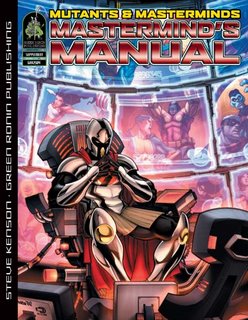 The core rules though are really good, and easy to vote for as often as possible. And the M&M campaign setting- Freedom City; well this is simply the single best setting product I have ever owned. So votes for this are a shoe-in too.
Black Industries get a look-in again this year, with their Realms of Sorcery nominated for Best Supplement. There are no M&M products nominated in this category, so that's another easy vote for me.
I will have to choose between Green Ronin and Black Industries when it comes to the Fans' Choice: Best Publisher category. I have enjoyed the most use and most entertainment from BI's products in the past year, and am looking forward to still more in the future. With M&M and True20 though GR have produced the products whose rules excite me most, and which I am most interested in using if I'm not GM'ing WFRP. The Old World or the new? Hmm.
Finally, on the 'Oh, dear me- NO!' front, I note that Hero Games' Pulp HERO garnered 2 nominations. One was Best Product, the other was Best Writing: "Awarded for the book containing the best prose and descriptive text (ie."cream" or “fluff”)." Erm, let's just say that I have a bee in my bonnet about this book, and really don't believe it deserves to win in either category. ;)
Ignorant of the ENies last year (shameful admission, eh?!), I first found out about them when the news broke that Black Industries' WFRP2 and the Old World Bestiary had taken 3 golds. I was pleased to see such success on the part of 2 products that I liked and which had brought me back into regular roleplaying. So I've decided to cast my votes this year.
Looking through the categories I see that Green Ronin's superhero rpg Mutants & Masterminds 2e is very well represented, with 9 nominations in 8 of the 16 categories. M&M 2e really impressed me when I got my copy last year, and the product line went straight onto my 'buy on sight' list. There is only 1 category in which GR's M&M won't be getting my vote- Best Interior Art for the Mastermind's Manual. Sure, there are some nice illustrations in that book, but there are easily enough that are indifferent or worse that I just can't cast a vote for this book in that category. In fact I doubt I could vote for the Mastermind's Manual at all if it wasn't for its lovely cover.
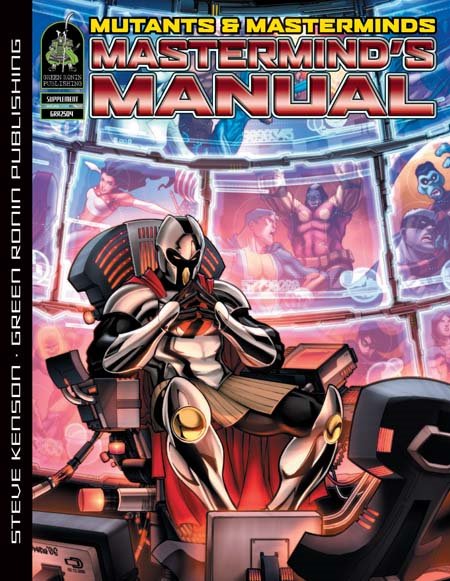 The core rules though are really good, and easy to vote for as often as possible. And the M&M campaign setting- Freedom City; well this is simply the single best setting product I have ever owned. So votes for this are a shoe-in too.
Black Industries get a look-in again this year, with their Realms of Sorcery nominated for Best Supplement. There are no M&M products nominated in this category, so that's another easy vote for me.
I will have to choose between Green Ronin and Black Industries when it comes to the Fans' Choice: Best Publisher category. I have enjoyed the most use and most entertainment from BI's products in the past year, and am looking forward to still more in the future. With M&M and True20 though GR have produced the products whose rules excite me most, and which I am most interested in using if I'm not GM'ing WFRP. The Old World or the new? Hmm.
Finally, on the 'Oh, dear me- NO!' front, I note that Hero Games' Pulp HERO garnered 2 nominations. One was Best Product, the other was Best Writing: "Awarded for the book containing the best prose and descriptive text (ie."cream" or “fluff”)." Erm, let's just say that I have a bee in my bonnet about this book, and really don't believe it deserves to win in either category. ;)
Monday, July 10, 2006
Got game- a badger strikes again!
So the inimitable Badger came round last Friday. After big plates of pasta and the mandatory BBC Radio 4 Friday night comedy slot- Armando Iannucci's Charm Offensive at the moment- we settled down to some serious gaming. Badger was delighted to see that I'd got the complete set of Memoir'44 and the new Commands and Colours: Ancients, so evening of trying out new stuff was in store for us both.
Commands and Colours: Ancients
Battle of Akragas
We got right down to business with some games of this all-new version of the Borg system with which we are both already so familiar. Starting at the beginning- as you do- we played a couple of games of 'Battle of Akragas' first, with Badger playing the Carthagians against my Syracusans. (You can click on the pictures to see larger versions btw.)
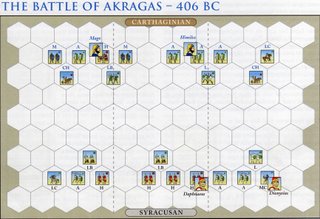 My strategy in each game was the same: form up my Heavy Infantry (H) into a single line and aim for the Carthaginian left. I had 2 reasons for this:
Anyhoo, I had a good hand of cards for my plan, and no pesky Light Bow units to get in the way of my heavies. So I was able to get my own line formed up and ready to go without too much difficulty. Badger meanwhile had managed to get his own infantry formed up into a single line across the battlefield. My heavies crashed into his line with the aid of a Double Time card and in 2 turns I had managed to tear a satisfyingly wide hole in the Carthaginian line.
Badger meanwhile managed to get his own Medium (M) and Heavy Infantry across the battlefield, and they were able to even the score a bit on his behalf. As this was happening I was able to bring up my reserves and readjust my forces for the final push against the shattered remants of Himilco's wing of the Carthaginian army which were pressed right back against the edge of the map. This went in; Badger countered; and the next thing I knew we were both at 4 victory banners and chasing just more kill each.
I was feeling quite confident at this point. Unfortunately Badger chose that moment to send his Chariots (CH) and a light infantry unit (one of the ones with a green unit symbol on it) from his right in against my isolated left flank units, which had barely moved throughout the game. Cleverly choosing to attack my Auxilia Infantry (A)- which can't evade- he had tragically little difficulty in sweeping them from the field and winning the day. Yes- it was that damn free banner I'd given Badger at the start of the game which had given him the game in the nick of time! Damn it all! Ouch.
Excited by the game and enthused by his victory Badger was ready and willing to wade into a straight replay- as was I, feeling that I had a point to prove.
The addition of the forgotten Light Bow units meant that the task of forming up my heavies into their battle line was a bit more fiddly, especially since I didn't have such a good hand to play with this time. Mind you, I had 2 extra units with which to cover my left flank, the importance of which was definitely in the forefront of my mind after the manner of Badger's previous victory.
Badger engaged in some skirmishing with his chariots as I was working on my line. This had the happy result that I was 2 victory banners up at little cost by the time I was contemplating the timing of my main assault. I only had 2 decent cards with which to carry this through- as opposed to the 4 or 5 I had in the previous game. I did consider fiddling about a bit while waiting for better cards, but Badger's massed ranks of light units with their missile weapons were in serious danger of whittling my heavies down quite significantly if I hung around too long. Nothing ventured I figured, and charged.
I can't remember quite how things went after that. So long story short: I won. Grins.
1-1
Crimmisos River
By this time quite delighted with the distinct atmosphere and unique tactical challenges of C&C:A relative to M44, Badger wanted more. So off we went to Crimmisos River.
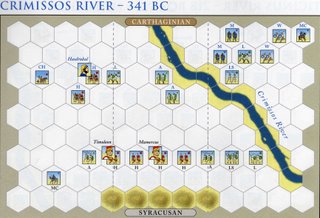 Badger chose to play the Carthaginians again, and to face up to the challenge of getting half of his army across the river.
Previous games having taught me some lessons about striking hard and fast, and not much fancying getting my own heavies tangled up with Badger's own, I swung to the right with my own line again. I quickly made contact with the Carthaginian centre, with little result other than sending some units back across the river. More importantly I suffered rather badly as the Carthaginians battled back against my heavies.
Then the Carthaginian right crashed in on my left flank. Before I knew where I was I had lost 2, maybe 3 units in the carnage and was facing a possible whitewash.
I managed to kill something to avoid utter humiliation. The Carthaginian right wing's attack meanwhile had stalled. So there I was, facing forces across the river on my right that actually outnumbered me, with elements on my left which would crush me from the rear if I tried to stop the river crossing. There was nothing for it: I had to form up into a line ahead (ie. north to south) and crush Hasdrubal's holding force before the Carthaginian left wing could get across the river.
My plan was helped by 2 significant circumstances:
Badger's Carthaginians weren't going to go down without a fight, that was for sure. His chariots swooped in and managed to force 2 (yes, 2!) of my units back onto the hills in a single turn. But my Syracusans were not going to let victory disappear from view after the efforts it had taken to bring it back into sight in the first place. I somehow held on against Badger's counterattacks and was able to win. I can't remember for sure, but I strongly suspect that battling back against a Carthaginian attack might've been what gave me my winning victory banner in the end. Grins.
We swapped sides for the final game. I started with just enough left section cards to give me a false sense of security about getting across the river. Unfortunately, managing to get 4 of my units moving and into the river fords pretty much straight off the bat just meant that my army was blocking its own retreats when Badger's attacks went in. So my expectations of a quick river crossing were confounded.
Getting my Carthaginian left wing across the river was never a serious prospect after that. The precise details of what happenend in the centre and on the other wing thereafter escape me, but the upshot of it all was that Badger's Syracusans won. Ouch.
2-2
Memoir'44
Time, we decided, to return to more familiar territory. So off it was to the Pacific Theatre to have another go with the Japanese against the Marines.
Leafing through the rulebook, Badger plumped for 'Matanikau River, Guadalcanal'. He played the Marines against my Japanese.
 Looking at all that dug-in infantry and artillery on the Marine's right I decided I wasn't going straight down their barrels. I set on the plan of working my armour round to back up that strong force of infantry on my own centre or right. This was a fiddly and time-consuming manoeuvre, involving- as it did- moving artillery and infantry out of the way to let the armour through. And all the while, that artillery I was so concerned about was raining down constant fire on my forward infantry units.
Badger was much aided in this by the Marines' special rule: basically they can issue an order to 1 additional unit with each card they play (you can find full details on page 6 here should you wish). This meant that Badger was often able to fire with 2 artillery units in the same turn; 3 in the same turn was painfully common too. The result was that even when I did try throwing some infantry forward to gain ground, they were quickly wiped out by a combination of artillery and infantry.
I tried this tactic for 2 games, to no avail. The main difference between the 2 games was that in the first I actually managed to establish a small bridgehead across the Matanikau River in the centre. This didn't survive long enough to be reinforced let alone exploited. Attempts to regain the bridgehead proved futile.
In the 2nd game I tried using that strong force of 5 infantry units on my own right to crush the Marine's open left flank. The result was no better than in the 1st game. In fact the fate of my men was tragically reminiscent of the proverbial 'death in a stream' that will be fondly remembered by any Up Front players among my readers. OUCH!
2-4
By this time Badger was getting too cocky for words, claiming that the scenario was unwinnable by the Japanese. This was the proverbial red rag.
Third time round I realised that I had no choice but to bite the bullet and head straight for those guns I had been so afraid of before. I brought my artillery forward so that one of them was neatly on the section dividing line. We swapped Barrages and engaged in an artillery duel, which resulted in the death of one of my artillery units (that one I'd carefully moved to maximise its usefulness too- dang!). Not an encouraging start I felt. Sheesh.
Fortunately I had a couple of good cards for ordering my infantry forward, and I was quickly able to get 4 infantry units into then across the stream and in among the Marines' positions. This was a very dangerous situation for Badger thanks to the Japanese special rules (page 6 here again), which allowed me to move 2 hexes and close assault; roll an extra dice in close assault with full strength infantry units; and ignore 1 flag each time the Marines attacked. Badger did his best to bring across reinforcements and to stem my rapid advance, but I had card after left section card with which to push my human wave forward, and he had next to nothing.
My lads overran the Marines' rear defences in no time at all, and I quickly won when I managed to exit a 2nd unit off the far board edge. A satisfying vindication and a delightful display of the Japanese in action. I'd won by playing straight to the Japanese strengths instead of getting involved in fiddly manoeuvres that simply ignored those strengths. Still... the night was Badger's in the end.
3-4
Gurns.
Epilogue
Badger's own thoughts about the night's games can be found here. His remark about Rome: Total War is interesting, and speaks well for R:TW and C&C:A both.
Oh, and Badger really isn't exaggerating about his artillery in the M44 game. It was exactly that much of a turkey shoot until I changed my tactics.
Commands and Colours: Ancients
Battle of Akragas
We got right down to business with some games of this all-new version of the Borg system with which we are both already so familiar. Starting at the beginning- as you do- we played a couple of games of 'Battle of Akragas' first, with Badger playing the Carthagians against my Syracusans. (You can click on the pictures to see larger versions btw.)
 My strategy in each game was the same: form up my Heavy Infantry (H) into a single line and aim for the Carthaginian left. I had 2 reasons for this:
- it is the weaker wing of the Carthaginian army
- my 2 Auxilia (A) units gave me better reserves on that flank.
Anyhoo, I had a good hand of cards for my plan, and no pesky Light Bow units to get in the way of my heavies. So I was able to get my own line formed up and ready to go without too much difficulty. Badger meanwhile had managed to get his own infantry formed up into a single line across the battlefield. My heavies crashed into his line with the aid of a Double Time card and in 2 turns I had managed to tear a satisfyingly wide hole in the Carthaginian line.
Badger meanwhile managed to get his own Medium (M) and Heavy Infantry across the battlefield, and they were able to even the score a bit on his behalf. As this was happening I was able to bring up my reserves and readjust my forces for the final push against the shattered remants of Himilco's wing of the Carthaginian army which were pressed right back against the edge of the map. This went in; Badger countered; and the next thing I knew we were both at 4 victory banners and chasing just more kill each.
I was feeling quite confident at this point. Unfortunately Badger chose that moment to send his Chariots (CH) and a light infantry unit (one of the ones with a green unit symbol on it) from his right in against my isolated left flank units, which had barely moved throughout the game. Cleverly choosing to attack my Auxilia Infantry (A)- which can't evade- he had tragically little difficulty in sweeping them from the field and winning the day. Yes- it was that damn free banner I'd given Badger at the start of the game which had given him the game in the nick of time! Damn it all! Ouch.
Excited by the game and enthused by his victory Badger was ready and willing to wade into a straight replay- as was I, feeling that I had a point to prove.
The addition of the forgotten Light Bow units meant that the task of forming up my heavies into their battle line was a bit more fiddly, especially since I didn't have such a good hand to play with this time. Mind you, I had 2 extra units with which to cover my left flank, the importance of which was definitely in the forefront of my mind after the manner of Badger's previous victory.
Badger engaged in some skirmishing with his chariots as I was working on my line. This had the happy result that I was 2 victory banners up at little cost by the time I was contemplating the timing of my main assault. I only had 2 decent cards with which to carry this through- as opposed to the 4 or 5 I had in the previous game. I did consider fiddling about a bit while waiting for better cards, but Badger's massed ranks of light units with their missile weapons were in serious danger of whittling my heavies down quite significantly if I hung around too long. Nothing ventured I figured, and charged.
I can't remember quite how things went after that. So long story short: I won. Grins.
1-1
Crimmisos River
By this time quite delighted with the distinct atmosphere and unique tactical challenges of C&C:A relative to M44, Badger wanted more. So off we went to Crimmisos River.
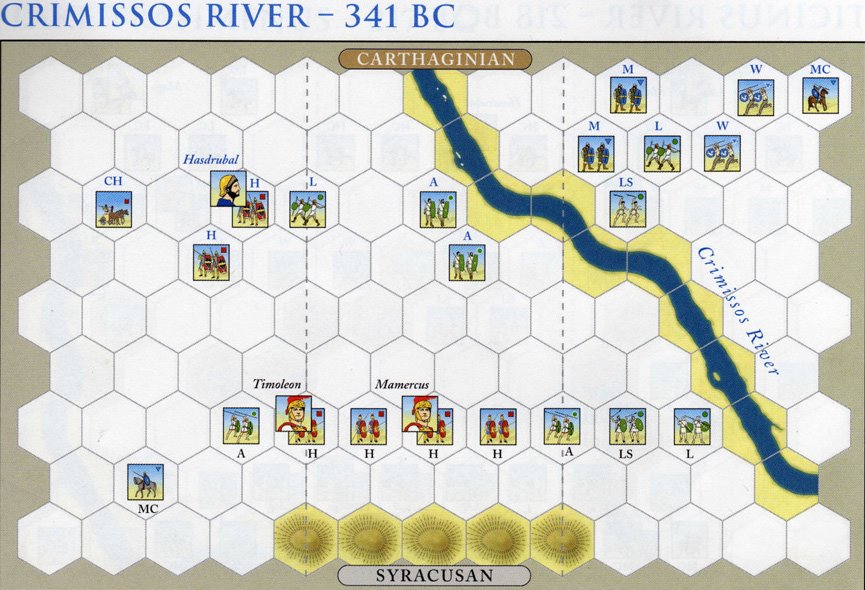 Badger chose to play the Carthaginians again, and to face up to the challenge of getting half of his army across the river.
Previous games having taught me some lessons about striking hard and fast, and not much fancying getting my own heavies tangled up with Badger's own, I swung to the right with my own line again. I quickly made contact with the Carthaginian centre, with little result other than sending some units back across the river. More importantly I suffered rather badly as the Carthaginians battled back against my heavies.
Then the Carthaginian right crashed in on my left flank. Before I knew where I was I had lost 2, maybe 3 units in the carnage and was facing a possible whitewash.
I managed to kill something to avoid utter humiliation. The Carthaginian right wing's attack meanwhile had stalled. So there I was, facing forces across the river on my right that actually outnumbered me, with elements on my left which would crush me from the rear if I tried to stop the river crossing. There was nothing for it: I had to form up into a line ahead (ie. north to south) and crush Hasdrubal's holding force before the Carthaginian left wing could get across the river.
My plan was helped by 2 significant circumstances:
- Hasdrubal's wing of the Carthaginian army was quite scattered, which maximised the effect of my own attacks.
- Badger still had 2 wings of his army to consider, whereas my own army was by now largely massed in the centre. Even if Badger was to chose to concentrate his efforts on Hasdrubal's counterattack, he could still be distracted by thoughts of getting reserves in from across the river.
Badger's Carthaginians weren't going to go down without a fight, that was for sure. His chariots swooped in and managed to force 2 (yes, 2!) of my units back onto the hills in a single turn. But my Syracusans were not going to let victory disappear from view after the efforts it had taken to bring it back into sight in the first place. I somehow held on against Badger's counterattacks and was able to win. I can't remember for sure, but I strongly suspect that battling back against a Carthaginian attack might've been what gave me my winning victory banner in the end. Grins.
We swapped sides for the final game. I started with just enough left section cards to give me a false sense of security about getting across the river. Unfortunately, managing to get 4 of my units moving and into the river fords pretty much straight off the bat just meant that my army was blocking its own retreats when Badger's attacks went in. So my expectations of a quick river crossing were confounded.
Getting my Carthaginian left wing across the river was never a serious prospect after that. The precise details of what happenend in the centre and on the other wing thereafter escape me, but the upshot of it all was that Badger's Syracusans won. Ouch.
2-2
Memoir'44
Time, we decided, to return to more familiar territory. So off it was to the Pacific Theatre to have another go with the Japanese against the Marines.
Leafing through the rulebook, Badger plumped for 'Matanikau River, Guadalcanal'. He played the Marines against my Japanese.
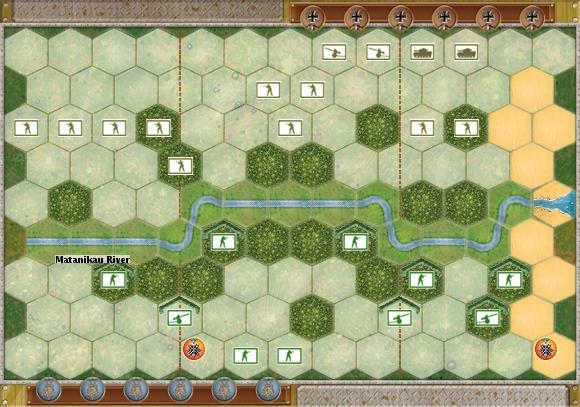 Looking at all that dug-in infantry and artillery on the Marine's right I decided I wasn't going straight down their barrels. I set on the plan of working my armour round to back up that strong force of infantry on my own centre or right. This was a fiddly and time-consuming manoeuvre, involving- as it did- moving artillery and infantry out of the way to let the armour through. And all the while, that artillery I was so concerned about was raining down constant fire on my forward infantry units.
Badger was much aided in this by the Marines' special rule: basically they can issue an order to 1 additional unit with each card they play (you can find full details on page 6 here should you wish). This meant that Badger was often able to fire with 2 artillery units in the same turn; 3 in the same turn was painfully common too. The result was that even when I did try throwing some infantry forward to gain ground, they were quickly wiped out by a combination of artillery and infantry.
I tried this tactic for 2 games, to no avail. The main difference between the 2 games was that in the first I actually managed to establish a small bridgehead across the Matanikau River in the centre. This didn't survive long enough to be reinforced let alone exploited. Attempts to regain the bridgehead proved futile.
In the 2nd game I tried using that strong force of 5 infantry units on my own right to crush the Marine's open left flank. The result was no better than in the 1st game. In fact the fate of my men was tragically reminiscent of the proverbial 'death in a stream' that will be fondly remembered by any Up Front players among my readers. OUCH!
2-4
By this time Badger was getting too cocky for words, claiming that the scenario was unwinnable by the Japanese. This was the proverbial red rag.
Third time round I realised that I had no choice but to bite the bullet and head straight for those guns I had been so afraid of before. I brought my artillery forward so that one of them was neatly on the section dividing line. We swapped Barrages and engaged in an artillery duel, which resulted in the death of one of my artillery units (that one I'd carefully moved to maximise its usefulness too- dang!). Not an encouraging start I felt. Sheesh.
Fortunately I had a couple of good cards for ordering my infantry forward, and I was quickly able to get 4 infantry units into then across the stream and in among the Marines' positions. This was a very dangerous situation for Badger thanks to the Japanese special rules (page 6 here again), which allowed me to move 2 hexes and close assault; roll an extra dice in close assault with full strength infantry units; and ignore 1 flag each time the Marines attacked. Badger did his best to bring across reinforcements and to stem my rapid advance, but I had card after left section card with which to push my human wave forward, and he had next to nothing.
My lads overran the Marines' rear defences in no time at all, and I quickly won when I managed to exit a 2nd unit off the far board edge. A satisfying vindication and a delightful display of the Japanese in action. I'd won by playing straight to the Japanese strengths instead of getting involved in fiddly manoeuvres that simply ignored those strengths. Still... the night was Badger's in the end.
3-4
Gurns.
Epilogue
Badger's own thoughts about the night's games can be found here. His remark about Rome: Total War is interesting, and speaks well for R:TW and C&C:A both.
Oh, and Badger really isn't exaggerating about his artillery in the M44 game. It was exactly that much of a turkey shoot until I changed my tactics.
Sunday, July 09, 2006
Commands and Colours: Ancients- the Richard Borg engine rumbles on! #2
This time I'm going to look more closely at each of the key rules changes outlined in the previous article.
The battle dice
One hit per unit type in C&C:A means that no unit type is more likely to be hit than any other. This is a significant change from M44, where the breakdown of unit-specific hits are a key feature of how the game models the variation in the vulnerability to fire of different types of unit on the battlefield. The swords are C&C:A's generic hit, just like the grenade in M44. The flag is similarly familiar. The leader hit is a special result which you can only gain if a unit attacking in close combat enjoys the benefits of a leader. Leader hits are also used to determine the chances of a leader being killed.
The new leader result aside, the most striking feature of C&C:A is that no unit type is inherently more vulnerable in close combat against any other unit type, eg. heavy infantry don't immediately hit any harder against light infantry than they do against medium infantry. I have read some complaints about this on the net, and I do think that it is counter-intuituve for players steeped in the comparisons of combat factors traditional in tabletop games and boardgames. I am not at all sure that this is as unrealistic as some have believed at first sight, but the subtleties are beyond me right now.
The Command deck
There are some major changes in the cards, in keeping with the new setting. The major change is that there are only 27 section cards to M44's 40. The range of section cards has also changed, being from 2, 3 or 4 units per section, as opposed to M44's 1, 2, 3 or all. There are still the familiar cards allowing units to be ordered on both flanks or in all sections.
The remainder of the Command deck is broken down into 3 kinds of cards- Troop, Leadership, and Tactic- as opposed to M44's Tactic cards. The Troop cards allow orders to be issued to units of a given troop type- heavy, medium, light or mounted. Leadership cards allow order to be issued to a leader, the unit to which it is attached, and to adjacent units. Tactics cards are the special orders familiar from M44, with a few additions suitable for the ancient setting.
Overall the effect of the redesigned deck is to focus relatively less on where the units are on the battlefield, and relatively more on what kind of units they are, or whether they are formed up into a line or under leadership. Altogether then the new deck is a significant element in generating the flavour of the period and in enforcing a different style of play in response to a specific set of problems. This is an impressive sign of the inherent flexibility of Borg's system.
Oh, and the Tactic card 'I Am Spartacus' qualifies as one of the most entertainingly named cards I have ever seen in a game. I defy anyone to play this card without announcing its name in a certain grandiose tone of voice!
Unit types
These provide a nice cross section of representative types. You have your basic light, medium and heavy infantry and cavalry. In addition you have light slingers and bowmen, auxilia- another class of light infantry, warriors- hard-hitting medium infantry who presumably represent warlike tribesmen, heavy chariots, and elephants (the last 2 are included in the general class of mounted units).
Each unit type has its own distinct capabilities, all of which are neatly summarised on handy reference sheets. All that is except for bowmen and slingers, which are identical in every respect, something which has been commented on here and there on the net. It'd be nice I guess if these units could've been differentiated somehow, but I confess I'm at a bit of a loss as to how this could've been done at the degree of resolution the basic Commands and Colours system allows.
The different unit types' movement rates are neatly differentiated. Medium and heavy foot units slog their way slowly across the battlefield at l hex/turn. Light foot are slightly faster with a move of 2, which enables them easily to keep up with heavy mounted units. Medium and light cavalry move at 3 and 4 hexes/turn respectively. When they move alone, leaders can move a comfortably nippy 3.
Unit types also determine battle dice in close combat (CC). Light units roll a puny 2 dice, which is extra puny if you consider that- the auxilia excepted- light units also can't count sword hits in close combat. Auxilia infantry roll 3 dice. Add in the fact that they can count sword hits and auxilia are fairly respectable 2nd line close combat units with the added bonus of missile fire. Medium and heavy infantry roll 4 and 5 dice respectively. The warrior unit has 4 dice which drop to 3 once it has lost a block. Medium and heavy cavalry roll 3 and 4 dice, while the chariots have 4 dice (3 if battling back). Elephants are covered below.
The dice in C&C:A then are flying thick and fast as compared to M44. Ranged attacks wil be rolling about as many dice as you'll find in the typical M44 attack (see below). Meanwhile most close combats will involve 3 or more dice. Leaving elephants aside for the moment, this can go as high as 7 dice in a single attack if you have heavy infantry attacking with the benefit of the 'Clash of Shields' Tactic card.
I'm no authority on the period, but these 12 units seem to cover all of the obvious bases. They certainly provide one of the main challenges of C&C:A, which is trying to make the most of what initially can be a bewildering variety of troop types. The learning curve here strikes me as being just a bit steeper than it is in M44, but it remains one of complex decisions given by simple elements. Full marks for flavour and gameplay on this score then.
Terrain
As anyone with even a passing knowledge of military history knows, battlefield terrain wasn't of the same importance in the ancient period as it was in WW2. The requirements of moving large formations of infantry in tightly packed ranks meant that ancient commanders typically sought out clear plains over which to face down their enemies. So most of the scenarios are fought across open maps.
All the same, some battles in the ancient period were decided by the impact of terrain. So there are several scenarios in C&C:A in which terrain plays a prominent part. In general, terrain is not your friend the way it is on the WW2 battlefield. Terrain that stops your movement on entry is likely to be more problematical in a game that puts such a high priority on maintaining battlelines. Similarly, I suspect that the battling back rules will place sufficient priority on striking first in close combat that losing the opportunity to battle after entering terrain could prove a more serious tactical burden than it is in M44. Finally, terrain that provides cover against incoming attacks is typically going to restrict outgoing attacks equally.
All of this means that heading as fast as possible for the nearest wood or hill is not necessarily the smart move in C&C:A that it usually is in M44. This seems quite reasonable to me.
Leaders
Leaders are a key element differentiating C&C:A from M44. Leaders are single block elements who can move individually if you wish. They are much more likely to operate attached to units though. Leaders allow the use of certain special Command cards. They also confer certain abilities in combat: to adjacent units- the units may count 1 extra result on each dice (the 'leader' hit) as hits in close combat; or to the unit to which they are attached- leader hits as before; also the unit may ignore a flag result (a retreat, just as in M44), and may also battle again if it advances after combat (otherwise restricted to warriors and mounted units).
So leaders make a unit much more likely to hold its place in your battle line as well as making his section of the battle much more hard hitting. It's easy to see therefore that the correct use of leaders is a key element of the game. This potentially game-winning influence is not without its risks though. Whenever a unit with an attached leader loses 1 or more blocks, there is a chance that the leader might be killed. And if he is killed, then that's a victory medal for your opponent as well as a bit of a kick in the teeth to your battle plans.
Support
Another simple little rule expressing period flavour and enforcing appropriate tactics, the support rule means that a unit with 2 friendly units in adjacent hexes can ignore the first retreat. The effect of this rule on play is to make isolated units and those on your flanks much more likely to break and run. This is particularly important in reducing the effects of missile fire to harassing fire and thus leaving the main basis of your assault to your harder hitting close combat units. All to the good it seems to me.
Ranged attacks
As befits a game whose subject is the clash of arms between massed ranks of fighters, ranged attacks in C&C:A are more limited than they are in M44. In a nutshell, only light units may make ranged attacks; they always roll 1 dice if they moved or 2 dice if they didn't; and ranged attacks can never count sword or leader hits. There are a couple of minor tweaks based on unit type- the main one being that dedicated missile units have a longer range than the rest, but otherwise the ranged attack rules are that simple.
The effect of these rules is to relegate missile fire to harassing attacks best used against the flanks of the enemy. Bringing your missile troops into the centre of the battlefield to make more serious attacks on the enemy line is certainly possible, but the vagaries of cardplay make this an unreliable tactic. And, of course, those pesky missile troops will then usually be in the way of your advancing battleline!
Retreats
Retreats are both potentially more dangerous and less likely in C&C:A than in M44. This is because each unit retreats its full movement allowance per flag instead of the 1 hex/flag of M44. At the same time, the penalty for being unable to retreat remains 1 block per hex that cannot be retreated. The result of this is that highly mobile units like light cavalry can easily be wiped out by a couple of flags forcing them to retreat 8 hexes and bringing them quickly up against their board edge.
At the same time, the rules for leaders and for support mean that most units in a battleline will ignore the first flag, so this tweak to the retreat rules will typically only scupper isolated units, or units on the open flanks, and evasion will often save those units in any case. Otherwise, if units do end up being forced to retreat then your carefully marshalled lines are going to get untidy pretty quickly.
Evasion
Another key rule differentiating C&C:A from M44, the evasion rules represent the often crucial tactic of the period- namely falling back in front of enemy charges that would otherwise utterly destroy your units. In C&C:A light units may always evade. Heavier mounted units can evade units which are heavier/less mobile than themselves, eg. heavy cavalry can evade foot units, heavy chariots or elephants, but not light or medium cavalry.
The evasion rules are quite simple in play: the attacker announces their attack; the defender declares if the target unit will evade; then the battle dice are rolled, but only hits based on unit type are counted- ie. no swords, flags or leader hits; then the evading unit must move 2 hexes back towards its own map edge. Evading is a key manoeuvre to prevent fast cavalry units from being destroyed by retreat results. Evasion is also useful because it prevents the attacker from advancing after combat and maybe getting another attack on your battleline.
Battling back
Another rule utterly definitive of C&C:A's period flavour, this rule allows units that didn't evade and which weren't forced to retreat to battle back against the unit that has just attacked them. There is no limit to how many times a unit can battle back in one turn, thus making it quite possible for prodigious feats of heroism by a lone unit when the dice decide to go to extremes.
There is little that need be said about this really: it makes perfect sense given the scale of the battles and the nature of the combat represented in C&C:A. Some people have complained about the absence of this rule in M44. I believe such criticisms are mistaken. But the absence of such a rule in C&C:A would've completely vitiated the game's claims to authenticity.
Elephants
Thanks perhaps largely to the exploits of Hannibal, elephants are as representative a feature of the ancient period in the popular imagination as are the Roman legions. So I don't think it's excessive to suggest that C&C:A is as liable to be judged by its rules for these unpredictable beasts as for the authenticity of its application of Borg's basic system.
I have to say that C&C:A's elephant rules look splendid. They are fragile- with only 2 blocks- but they ignore all sword hits, plus 1 hit and 1 flag against other mounted units, to represent the way they unnerved horses. In the attack they roll as many dice against a unit as that unit itself rolls in battle, with the addition that they take all sword results and roll them again for possible extra damage. (And yes, this does mean that a single elephant unit could- theoretically at least- roll an infinite number of dice in one battle! Of course the practical limit to that is that no unit has more than 4 blocks.) Then they can advance and battle again. The prospects for carnage against say, heavy infantry, are positively mouth-watering!
On top of that, if an elephant unit is forced to retreat, it immediately rampages. An elephant rampage is a free attack against each and every adjacent unit, friendly or enemy. And as if that wasn't enough, if an elephant unit's retreat is blocked, the blocking units suffer a hit for each hex the elephant unit is unable to retreat. Again, rules that promise moments of great entertainment even if they might prove occasionally very painful.
The battle dice
One hit per unit type in C&C:A means that no unit type is more likely to be hit than any other. This is a significant change from M44, where the breakdown of unit-specific hits are a key feature of how the game models the variation in the vulnerability to fire of different types of unit on the battlefield. The swords are C&C:A's generic hit, just like the grenade in M44. The flag is similarly familiar. The leader hit is a special result which you can only gain if a unit attacking in close combat enjoys the benefits of a leader. Leader hits are also used to determine the chances of a leader being killed.
The new leader result aside, the most striking feature of C&C:A is that no unit type is inherently more vulnerable in close combat against any other unit type, eg. heavy infantry don't immediately hit any harder against light infantry than they do against medium infantry. I have read some complaints about this on the net, and I do think that it is counter-intuituve for players steeped in the comparisons of combat factors traditional in tabletop games and boardgames. I am not at all sure that this is as unrealistic as some have believed at first sight, but the subtleties are beyond me right now.
The Command deck
There are some major changes in the cards, in keeping with the new setting. The major change is that there are only 27 section cards to M44's 40. The range of section cards has also changed, being from 2, 3 or 4 units per section, as opposed to M44's 1, 2, 3 or all. There are still the familiar cards allowing units to be ordered on both flanks or in all sections.
The remainder of the Command deck is broken down into 3 kinds of cards- Troop, Leadership, and Tactic- as opposed to M44's Tactic cards. The Troop cards allow orders to be issued to units of a given troop type- heavy, medium, light or mounted. Leadership cards allow order to be issued to a leader, the unit to which it is attached, and to adjacent units. Tactics cards are the special orders familiar from M44, with a few additions suitable for the ancient setting.
Overall the effect of the redesigned deck is to focus relatively less on where the units are on the battlefield, and relatively more on what kind of units they are, or whether they are formed up into a line or under leadership. Altogether then the new deck is a significant element in generating the flavour of the period and in enforcing a different style of play in response to a specific set of problems. This is an impressive sign of the inherent flexibility of Borg's system.
Oh, and the Tactic card 'I Am Spartacus' qualifies as one of the most entertainingly named cards I have ever seen in a game. I defy anyone to play this card without announcing its name in a certain grandiose tone of voice!
Unit types
These provide a nice cross section of representative types. You have your basic light, medium and heavy infantry and cavalry. In addition you have light slingers and bowmen, auxilia- another class of light infantry, warriors- hard-hitting medium infantry who presumably represent warlike tribesmen, heavy chariots, and elephants (the last 2 are included in the general class of mounted units).
Each unit type has its own distinct capabilities, all of which are neatly summarised on handy reference sheets. All that is except for bowmen and slingers, which are identical in every respect, something which has been commented on here and there on the net. It'd be nice I guess if these units could've been differentiated somehow, but I confess I'm at a bit of a loss as to how this could've been done at the degree of resolution the basic Commands and Colours system allows.
The different unit types' movement rates are neatly differentiated. Medium and heavy foot units slog their way slowly across the battlefield at l hex/turn. Light foot are slightly faster with a move of 2, which enables them easily to keep up with heavy mounted units. Medium and light cavalry move at 3 and 4 hexes/turn respectively. When they move alone, leaders can move a comfortably nippy 3.
Unit types also determine battle dice in close combat (CC). Light units roll a puny 2 dice, which is extra puny if you consider that- the auxilia excepted- light units also can't count sword hits in close combat. Auxilia infantry roll 3 dice. Add in the fact that they can count sword hits and auxilia are fairly respectable 2nd line close combat units with the added bonus of missile fire. Medium and heavy infantry roll 4 and 5 dice respectively. The warrior unit has 4 dice which drop to 3 once it has lost a block. Medium and heavy cavalry roll 3 and 4 dice, while the chariots have 4 dice (3 if battling back). Elephants are covered below.
The dice in C&C:A then are flying thick and fast as compared to M44. Ranged attacks wil be rolling about as many dice as you'll find in the typical M44 attack (see below). Meanwhile most close combats will involve 3 or more dice. Leaving elephants aside for the moment, this can go as high as 7 dice in a single attack if you have heavy infantry attacking with the benefit of the 'Clash of Shields' Tactic card.
I'm no authority on the period, but these 12 units seem to cover all of the obvious bases. They certainly provide one of the main challenges of C&C:A, which is trying to make the most of what initially can be a bewildering variety of troop types. The learning curve here strikes me as being just a bit steeper than it is in M44, but it remains one of complex decisions given by simple elements. Full marks for flavour and gameplay on this score then.
Terrain
As anyone with even a passing knowledge of military history knows, battlefield terrain wasn't of the same importance in the ancient period as it was in WW2. The requirements of moving large formations of infantry in tightly packed ranks meant that ancient commanders typically sought out clear plains over which to face down their enemies. So most of the scenarios are fought across open maps.
All the same, some battles in the ancient period were decided by the impact of terrain. So there are several scenarios in C&C:A in which terrain plays a prominent part. In general, terrain is not your friend the way it is on the WW2 battlefield. Terrain that stops your movement on entry is likely to be more problematical in a game that puts such a high priority on maintaining battlelines. Similarly, I suspect that the battling back rules will place sufficient priority on striking first in close combat that losing the opportunity to battle after entering terrain could prove a more serious tactical burden than it is in M44. Finally, terrain that provides cover against incoming attacks is typically going to restrict outgoing attacks equally.
All of this means that heading as fast as possible for the nearest wood or hill is not necessarily the smart move in C&C:A that it usually is in M44. This seems quite reasonable to me.
Leaders
Leaders are a key element differentiating C&C:A from M44. Leaders are single block elements who can move individually if you wish. They are much more likely to operate attached to units though. Leaders allow the use of certain special Command cards. They also confer certain abilities in combat: to adjacent units- the units may count 1 extra result on each dice (the 'leader' hit) as hits in close combat; or to the unit to which they are attached- leader hits as before; also the unit may ignore a flag result (a retreat, just as in M44), and may also battle again if it advances after combat (otherwise restricted to warriors and mounted units).
So leaders make a unit much more likely to hold its place in your battle line as well as making his section of the battle much more hard hitting. It's easy to see therefore that the correct use of leaders is a key element of the game. This potentially game-winning influence is not without its risks though. Whenever a unit with an attached leader loses 1 or more blocks, there is a chance that the leader might be killed. And if he is killed, then that's a victory medal for your opponent as well as a bit of a kick in the teeth to your battle plans.
Support
Another simple little rule expressing period flavour and enforcing appropriate tactics, the support rule means that a unit with 2 friendly units in adjacent hexes can ignore the first retreat. The effect of this rule on play is to make isolated units and those on your flanks much more likely to break and run. This is particularly important in reducing the effects of missile fire to harassing fire and thus leaving the main basis of your assault to your harder hitting close combat units. All to the good it seems to me.
Ranged attacks
As befits a game whose subject is the clash of arms between massed ranks of fighters, ranged attacks in C&C:A are more limited than they are in M44. In a nutshell, only light units may make ranged attacks; they always roll 1 dice if they moved or 2 dice if they didn't; and ranged attacks can never count sword or leader hits. There are a couple of minor tweaks based on unit type- the main one being that dedicated missile units have a longer range than the rest, but otherwise the ranged attack rules are that simple.
The effect of these rules is to relegate missile fire to harassing attacks best used against the flanks of the enemy. Bringing your missile troops into the centre of the battlefield to make more serious attacks on the enemy line is certainly possible, but the vagaries of cardplay make this an unreliable tactic. And, of course, those pesky missile troops will then usually be in the way of your advancing battleline!
Retreats
Retreats are both potentially more dangerous and less likely in C&C:A than in M44. This is because each unit retreats its full movement allowance per flag instead of the 1 hex/flag of M44. At the same time, the penalty for being unable to retreat remains 1 block per hex that cannot be retreated. The result of this is that highly mobile units like light cavalry can easily be wiped out by a couple of flags forcing them to retreat 8 hexes and bringing them quickly up against their board edge.
At the same time, the rules for leaders and for support mean that most units in a battleline will ignore the first flag, so this tweak to the retreat rules will typically only scupper isolated units, or units on the open flanks, and evasion will often save those units in any case. Otherwise, if units do end up being forced to retreat then your carefully marshalled lines are going to get untidy pretty quickly.
Evasion
Another key rule differentiating C&C:A from M44, the evasion rules represent the often crucial tactic of the period- namely falling back in front of enemy charges that would otherwise utterly destroy your units. In C&C:A light units may always evade. Heavier mounted units can evade units which are heavier/less mobile than themselves, eg. heavy cavalry can evade foot units, heavy chariots or elephants, but not light or medium cavalry.
The evasion rules are quite simple in play: the attacker announces their attack; the defender declares if the target unit will evade; then the battle dice are rolled, but only hits based on unit type are counted- ie. no swords, flags or leader hits; then the evading unit must move 2 hexes back towards its own map edge. Evading is a key manoeuvre to prevent fast cavalry units from being destroyed by retreat results. Evasion is also useful because it prevents the attacker from advancing after combat and maybe getting another attack on your battleline.
Battling back
Another rule utterly definitive of C&C:A's period flavour, this rule allows units that didn't evade and which weren't forced to retreat to battle back against the unit that has just attacked them. There is no limit to how many times a unit can battle back in one turn, thus making it quite possible for prodigious feats of heroism by a lone unit when the dice decide to go to extremes.
There is little that need be said about this really: it makes perfect sense given the scale of the battles and the nature of the combat represented in C&C:A. Some people have complained about the absence of this rule in M44. I believe such criticisms are mistaken. But the absence of such a rule in C&C:A would've completely vitiated the game's claims to authenticity.
Elephants
Thanks perhaps largely to the exploits of Hannibal, elephants are as representative a feature of the ancient period in the popular imagination as are the Roman legions. So I don't think it's excessive to suggest that C&C:A is as liable to be judged by its rules for these unpredictable beasts as for the authenticity of its application of Borg's basic system.
I have to say that C&C:A's elephant rules look splendid. They are fragile- with only 2 blocks- but they ignore all sword hits, plus 1 hit and 1 flag against other mounted units, to represent the way they unnerved horses. In the attack they roll as many dice against a unit as that unit itself rolls in battle, with the addition that they take all sword results and roll them again for possible extra damage. (And yes, this does mean that a single elephant unit could- theoretically at least- roll an infinite number of dice in one battle! Of course the practical limit to that is that no unit has more than 4 blocks.) Then they can advance and battle again. The prospects for carnage against say, heavy infantry, are positively mouth-watering!
On top of that, if an elephant unit is forced to retreat, it immediately rampages. An elephant rampage is a free attack against each and every adjacent unit, friendly or enemy. And as if that wasn't enough, if an elephant unit's retreat is blocked, the blocking units suffer a hit for each hex the elephant unit is unable to retreat. Again, rules that promise moments of great entertainment even if they might prove occasionally very painful.
Saturday, July 08, 2006
Unutterably Fabulous!
"Burning up a sun just to say goodbye..."
So there we go, the last episode of the current series of Doctor Who, with the much anticipated- and somewhat dreaded- departure of Rose. And what an episode!- 45 minutes of rip-snortin', gut-wrenching, action-packed non-stop excitement, easily the best TV I've seen all year.
I mean, just how could you top the last series finale, with that awesome Dalek attack fleet swooping in from space only to be turned to dust by Rose in an attack of TARDIS-induced godhesshood? Well the Daleks versus the Cybermen for the first ever time just couldn't go wrong. Well four Daleks against 5 million Cybermen to be precise. And you know who my money was on? And the trash-talking between the 2 bands of would-be tinpot tyrants was just brilliant too: "This is not war, this is pest control." Sweet joy!
And then there was Rose's departure. Avoiding spoilers all I can say is that this was thrilling and heart-breaking at the same time. Everything that Rose has been throughout 2 series- in herself and to the Doctor- was taken and ramped up to the max with real panache. Fans of the series and of Billie Piper herself can take comfort in the quality of this final story featuring her definitive take on one of the classic SF heroine roles on the silver screen. It was worthy.
Meanwhile there might be some readers out there who haven't yet heard the news about the Doctor's new assistant, who was announced last Wednesday.
 Actress Freema Agyeman has a hard act to follow, harder even perhaps than did David Tennant when he took over from Christopher Eccleston. All that I can say as early as this is that I think it was a good choice on the part of the series producers to pick such a contrasting look for the new companion. I wonder where Russell T. Davies will want to take the character?
Well that's Doctor Who for another year. Now we wait. ;)
So there we go, the last episode of the current series of Doctor Who, with the much anticipated- and somewhat dreaded- departure of Rose. And what an episode!- 45 minutes of rip-snortin', gut-wrenching, action-packed non-stop excitement, easily the best TV I've seen all year.
I mean, just how could you top the last series finale, with that awesome Dalek attack fleet swooping in from space only to be turned to dust by Rose in an attack of TARDIS-induced godhesshood? Well the Daleks versus the Cybermen for the first ever time just couldn't go wrong. Well four Daleks against 5 million Cybermen to be precise. And you know who my money was on? And the trash-talking between the 2 bands of would-be tinpot tyrants was just brilliant too: "This is not war, this is pest control." Sweet joy!
And then there was Rose's departure. Avoiding spoilers all I can say is that this was thrilling and heart-breaking at the same time. Everything that Rose has been throughout 2 series- in herself and to the Doctor- was taken and ramped up to the max with real panache. Fans of the series and of Billie Piper herself can take comfort in the quality of this final story featuring her definitive take on one of the classic SF heroine roles on the silver screen. It was worthy.
Meanwhile there might be some readers out there who haven't yet heard the news about the Doctor's new assistant, who was announced last Wednesday.
 Actress Freema Agyeman has a hard act to follow, harder even perhaps than did David Tennant when he took over from Christopher Eccleston. All that I can say as early as this is that I think it was a good choice on the part of the series producers to pick such a contrasting look for the new companion. I wonder where Russell T. Davies will want to take the character?
Well that's Doctor Who for another year. Now we wait. ;)
My little Old World: The Madness of Father Ranulf #2
... Oh, the madness!
The following evening the PC's found themselves in the Scholar's in the Freiburg. The night had barely begun when the same Bartomar who Berthold saw before came hurtling in. He breathlessly explained that Sister Delfholt needed their help. The PC's didn't need telling that something was happening with Father Ranulf, so they followed the messenger out into the dark streets of the city.
Sister Delfholt was waiting for the PC's by the Black Plague Memorial. Quickly she explained that the Temple had receieved the news about the fate of Odo's remains that day- no one could remember them being disposed of at all, certainly no one at the Morrspark. On hearing the news Ranulf went absolutely berserk and ran out into the streets. Staff from the Temple of Shallya gave chase and purused him as far as the Temple of Ulric, at which point they tried in vain to persuade Ranulf to return to the Temple with them. He ran off back the way he'd come instead, and was last seen heading into the Morrspark. Sister Delfholt decided to rely on the PC's because Ranulf seems to trust them.
With Sister Delfholt in tow the PC's headed into the Morrspark. The stench of burnt human flesh from the great pyres of the dead from the siege still hung in the air, and the Morrspark ravens took wing as they were disturbed and circled above, cawing. Father Ranulf was quickly found, near the eastern edge just a few yards south of the shrine to Morr. He was beside himself with agitation and was digging frantically in the soft earth with his bare hands.
The PC's tried persuade Father Ranulf to return to the Temple and the priest began to calm down. Then Sister Delfholt shouted a warning. Looking round to where she was pointing the PC's could see beady yellow eyes watching them from the direction of where the party entered the sewers some 3 months ago. Before anyone had had time to digest this discovery 2 Skaven charged out from among the headstones in the opposite direction and launched attacks against Alane and Berthold.
The pair survived the surprise attacks, and melee was engaged. As Siegfreid prepared to engage he felt something swoosh past his head in the darkness. Fearing missile attacks he tried to force Father Ranulf into cover. Sister Delfholt soon came to his aid, and he moved in to attack as 3 more Skaven came charging out of the night.
Having come straight from his researches at the Collegium Theologica Berthold was armed with nothing more than his knife, so he quickly broke off from the Skaven that had attacked him and moved to Seigfreid's side for support. Meanwhile Alane cast a light spell on her quarterstaff so that her companions could fight the ratmen on equal terms in the darkness. By this time enraged animal shrieks could be heard from where the eyes had been seen before the surprise attack had been launched.
The fight raged on. More of the blowpipe darts that had narrowly missed Seigfried flew around. Two of them hit Sister Delfholt, to no apparent ill-effect. The Skaven pressed their attacks home with some vigour, dealing out serious wounds to Berthold and the Shallyan sister, who was forced to defend herself. The combination of Seigfried's vicious attacks and Alane's magic darts quickly began to tell. The benefits of surprise and the darkness lost and their numbers dwindling, the Skaven faltered, but commanding shrieks from behind kept the survivors from flight. All the same barely a minute after the attack had been launched the last Skaven's nerve gave and it turned and fled into the night.
Leaving Sister Delfholt to attend to her own and Berthold's wounds, Seigfried ran straight for the edge of the Morrspark. Scrambling over the railings he made straight for the sewer entrance he remembered from his previous encounter with the vile ratmen. Crouching down to peer in he heard the scrape of a claw on stone behind him, and was able to twist out of the way of a Skaven sword at the last moment.
Meanwhile Alane too was clambering over the Morrspark railings and hastening to Siegfried's assistance.
Turning to face his attacker Seigfried saw a strangely familiar Skaven bearing down on him in sheer and utter rage. He was the leader who had escaped from the party when they had attacked the Skaven lair months before. The vengeful Skaven was at least as fast and skillful with its blade as was Seigfried with his, but the fight was short and brutal. Almost before the Skaven knew what had hit him, he was wounded, then Siegfried finished him off with a thrust to the arm that opened an artery and emptied the creature of much as half of its blood before it could blink.
Alane arrived just in time to see the Skaven fall. Together the elf and the human peered down into the sewer. Thankfully there were no Skaven in sight. They could see something though, a fleshly lump the size of a large dog. As they stared down wondering what it was, they could hear the sound of claws scraping on stone and a pathetic mewling from the lump. Noting the lump's utter stillness they decided to investigate.
Reaching the thing in the sewer the PC's were horrified to realise that it was a portion of the twisted remains of what had once been Father Odo. The mewling came from a giant rat lying behind the hideous carcass. The rat had a puny tentacle sticking out of its distended stomach. As the PC's looked closer the giant rat's tentacle was reaching out feebly towards the horribly warped remains of the blind priest, which, they saw, had been gnawed away here and there. Some of the bites were fresh enough still to be oozing too. The sight was too much for Seigfried who felt something give way in the depths of his mind.
Utterly unwilling to leave this grotesque... thing in Skaven hands, Alane and Seigfried formed a quick plan. Alane headed off to collect some equipment from the Gilded Swallow while Seigfried stayed to keep watch.
While all this had been happening Berthold had accompanied Sister Delfholt and Father Ranulf back to the Temple of Shallya. This done he too headed to the Gilded Swallow to collect some of his own equipment. He and Alane met up at the inn and together they made their way to back to the Ulricsmund to rejoin Seigfried. They arrived to discover that 2 Skaven had crept up the sewer and- despite Seigfried's best efforts throwing his daggers- had begun slowly to drag the chaos-spawned carcass away.
Our PC's took one look at each other, and headed into the sewer. Unfortunately they had forgotten the lessons of their previous descent into the filthly underworld, and neglected to prepare themselves against the stench. This was to have deadly consequences.
Siegfried went first, closely followed by Alane then Berthold. As our heroes made their way down the narrow ledge they could see that there were 2 more Skaven positioned back down the tunnel, and what turned out to be several giant rats further back. Siegfried charged in against one of the Skaven dragging the carcass away, while Berthold jumped into the sewer channel and waded-in against the other.
As ever, Siegfried had little difficulty in despatching his foe. Berthold too was doing fairly well, eventually forcing it to retreat after crippling its arm. Unfortunately the Skaven were as well prepared and well led as our PC's had been hasty and rash. Another Skaven way back down the sewer tunnel shouted out, and the 5 giant rats- some of them strangely malformed- scurried forward. Meanwhile the 2 Skaven further back down the tunnel kept up a regular slingfire.
This combination of giant rats and slingshots proved deadly in the confined spaces of the sewers. Siegfried went down on top of a giant rat which, pushing its way out from under him, toppled him into the effluent channel. Regaining his feet and hacking into a giant rat, Seigfried was felled by a slingshot. Berthold was preparing to grab his companion and haul him to safety in a prompt retreat, when he too was felled by a slingshot to the temple.
By this time the Skaven Packmaster commanding the rats had moved forward, had used his Things-Catcher to secure the carcass, and was preparing to haul it away. Alone down the sewers and confronted by 2 uncannily accurate Skaven slingers, 5 mutated giant rats, and unknown other Skaven, Alane did the sensible thing- she turned and fled.
Four days later, Seigfried and Berthold's battered bodies having been retrieved by the Watch and tended back to health by the Sisters of Shallya, the PC's were summoned before Commander Schutzmann. Questioned in minute detail by the Middenmarshal about the events in which they had become involved, they left the Watch headquarters realising they had foiled another serious plot. A Skaven plan to undermine Middenheim by infesting the Temple of Shallya with mutated giant rats might not have threatened the unity of the entire Empire as had Liebnitz's scheme, but Schutzmann was certainly relieved to know that the plan had failed, even if only for the moment.
Our PC's, on the other hand- anonymous heroes yet again- no longer felt quite so divinely blessed by the hand of Ulric as they had only scant days before. They had also learned that Liebnitz's evil acts could reach out to haunt them even after his death.
And- to cap it all, Siegfried had missed his romantic assignation!
Related@RD/KA!
The Madness of Father Ranulf
- #2 The madness...
- Index:- My little Old World: Ashes of Middenheim
The following evening the PC's found themselves in the Scholar's in the Freiburg. The night had barely begun when the same Bartomar who Berthold saw before came hurtling in. He breathlessly explained that Sister Delfholt needed their help. The PC's didn't need telling that something was happening with Father Ranulf, so they followed the messenger out into the dark streets of the city.
Sister Delfholt was waiting for the PC's by the Black Plague Memorial. Quickly she explained that the Temple had receieved the news about the fate of Odo's remains that day- no one could remember them being disposed of at all, certainly no one at the Morrspark. On hearing the news Ranulf went absolutely berserk and ran out into the streets. Staff from the Temple of Shallya gave chase and purused him as far as the Temple of Ulric, at which point they tried in vain to persuade Ranulf to return to the Temple with them. He ran off back the way he'd come instead, and was last seen heading into the Morrspark. Sister Delfholt decided to rely on the PC's because Ranulf seems to trust them.
With Sister Delfholt in tow the PC's headed into the Morrspark. The stench of burnt human flesh from the great pyres of the dead from the siege still hung in the air, and the Morrspark ravens took wing as they were disturbed and circled above, cawing. Father Ranulf was quickly found, near the eastern edge just a few yards south of the shrine to Morr. He was beside himself with agitation and was digging frantically in the soft earth with his bare hands.
The PC's tried persuade Father Ranulf to return to the Temple and the priest began to calm down. Then Sister Delfholt shouted a warning. Looking round to where she was pointing the PC's could see beady yellow eyes watching them from the direction of where the party entered the sewers some 3 months ago. Before anyone had had time to digest this discovery 2 Skaven charged out from among the headstones in the opposite direction and launched attacks against Alane and Berthold.
The pair survived the surprise attacks, and melee was engaged. As Siegfreid prepared to engage he felt something swoosh past his head in the darkness. Fearing missile attacks he tried to force Father Ranulf into cover. Sister Delfholt soon came to his aid, and he moved in to attack as 3 more Skaven came charging out of the night.
Having come straight from his researches at the Collegium Theologica Berthold was armed with nothing more than his knife, so he quickly broke off from the Skaven that had attacked him and moved to Seigfreid's side for support. Meanwhile Alane cast a light spell on her quarterstaff so that her companions could fight the ratmen on equal terms in the darkness. By this time enraged animal shrieks could be heard from where the eyes had been seen before the surprise attack had been launched.
The fight raged on. More of the blowpipe darts that had narrowly missed Seigfried flew around. Two of them hit Sister Delfholt, to no apparent ill-effect. The Skaven pressed their attacks home with some vigour, dealing out serious wounds to Berthold and the Shallyan sister, who was forced to defend herself. The combination of Seigfried's vicious attacks and Alane's magic darts quickly began to tell. The benefits of surprise and the darkness lost and their numbers dwindling, the Skaven faltered, but commanding shrieks from behind kept the survivors from flight. All the same barely a minute after the attack had been launched the last Skaven's nerve gave and it turned and fled into the night.
Leaving Sister Delfholt to attend to her own and Berthold's wounds, Seigfried ran straight for the edge of the Morrspark. Scrambling over the railings he made straight for the sewer entrance he remembered from his previous encounter with the vile ratmen. Crouching down to peer in he heard the scrape of a claw on stone behind him, and was able to twist out of the way of a Skaven sword at the last moment.
Meanwhile Alane too was clambering over the Morrspark railings and hastening to Siegfried's assistance.
Turning to face his attacker Seigfried saw a strangely familiar Skaven bearing down on him in sheer and utter rage. He was the leader who had escaped from the party when they had attacked the Skaven lair months before. The vengeful Skaven was at least as fast and skillful with its blade as was Seigfried with his, but the fight was short and brutal. Almost before the Skaven knew what had hit him, he was wounded, then Siegfried finished him off with a thrust to the arm that opened an artery and emptied the creature of much as half of its blood before it could blink.
Alane arrived just in time to see the Skaven fall. Together the elf and the human peered down into the sewer. Thankfully there were no Skaven in sight. They could see something though, a fleshly lump the size of a large dog. As they stared down wondering what it was, they could hear the sound of claws scraping on stone and a pathetic mewling from the lump. Noting the lump's utter stillness they decided to investigate.
Reaching the thing in the sewer the PC's were horrified to realise that it was a portion of the twisted remains of what had once been Father Odo. The mewling came from a giant rat lying behind the hideous carcass. The rat had a puny tentacle sticking out of its distended stomach. As the PC's looked closer the giant rat's tentacle was reaching out feebly towards the horribly warped remains of the blind priest, which, they saw, had been gnawed away here and there. Some of the bites were fresh enough still to be oozing too. The sight was too much for Seigfried who felt something give way in the depths of his mind.
Utterly unwilling to leave this grotesque... thing in Skaven hands, Alane and Seigfried formed a quick plan. Alane headed off to collect some equipment from the Gilded Swallow while Seigfried stayed to keep watch.
While all this had been happening Berthold had accompanied Sister Delfholt and Father Ranulf back to the Temple of Shallya. This done he too headed to the Gilded Swallow to collect some of his own equipment. He and Alane met up at the inn and together they made their way to back to the Ulricsmund to rejoin Seigfried. They arrived to discover that 2 Skaven had crept up the sewer and- despite Seigfried's best efforts throwing his daggers- had begun slowly to drag the chaos-spawned carcass away.
Our PC's took one look at each other, and headed into the sewer. Unfortunately they had forgotten the lessons of their previous descent into the filthly underworld, and neglected to prepare themselves against the stench. This was to have deadly consequences.
Siegfried went first, closely followed by Alane then Berthold. As our heroes made their way down the narrow ledge they could see that there were 2 more Skaven positioned back down the tunnel, and what turned out to be several giant rats further back. Siegfried charged in against one of the Skaven dragging the carcass away, while Berthold jumped into the sewer channel and waded-in against the other.
As ever, Siegfried had little difficulty in despatching his foe. Berthold too was doing fairly well, eventually forcing it to retreat after crippling its arm. Unfortunately the Skaven were as well prepared and well led as our PC's had been hasty and rash. Another Skaven way back down the sewer tunnel shouted out, and the 5 giant rats- some of them strangely malformed- scurried forward. Meanwhile the 2 Skaven further back down the tunnel kept up a regular slingfire.
This combination of giant rats and slingshots proved deadly in the confined spaces of the sewers. Siegfried went down on top of a giant rat which, pushing its way out from under him, toppled him into the effluent channel. Regaining his feet and hacking into a giant rat, Seigfried was felled by a slingshot. Berthold was preparing to grab his companion and haul him to safety in a prompt retreat, when he too was felled by a slingshot to the temple.
By this time the Skaven Packmaster commanding the rats had moved forward, had used his Things-Catcher to secure the carcass, and was preparing to haul it away. Alone down the sewers and confronted by 2 uncannily accurate Skaven slingers, 5 mutated giant rats, and unknown other Skaven, Alane did the sensible thing- she turned and fled.
Four days later, Seigfried and Berthold's battered bodies having been retrieved by the Watch and tended back to health by the Sisters of Shallya, the PC's were summoned before Commander Schutzmann. Questioned in minute detail by the Middenmarshal about the events in which they had become involved, they left the Watch headquarters realising they had foiled another serious plot. A Skaven plan to undermine Middenheim by infesting the Temple of Shallya with mutated giant rats might not have threatened the unity of the entire Empire as had Liebnitz's scheme, but Schutzmann was certainly relieved to know that the plan had failed, even if only for the moment.
Our PC's, on the other hand- anonymous heroes yet again- no longer felt quite so divinely blessed by the hand of Ulric as they had only scant days before. They had also learned that Liebnitz's evil acts could reach out to haunt them even after his death.
And- to cap it all, Siegfried had missed his romantic assignation!
Related@RD/KA!
The Madness of Father Ranulf
- #2 The madness...
- Index:- My little Old World: Ashes of Middenheim
Friday, July 07, 2006
Confessions of a Completist
Or: I bare my buyer's angst (Ooo-er...)
So, I headed off into town yesterday to visit Static Games, hoping there to find the newly released Pacific Theatre expansion for Memoir'44. My luck was in and I soon had a copy of this long-awaited product in my hands.
Clutching my prize I wandered around the store, as you do. Knowing that a new WFRP supplement is due I checked that section of the racks. No joy. Then I decided to see if there were any interesting 2nd hand 1st edition WFRP books in the nearby rack. What should I see but both volumes of the legendary Warhammer Realm of Chaos books, that is both Slaves to Darkness and The Lost and the Damned. I almost couldn't believe my eyes. I mean, I've actually only ever seen these books once before IIRC, and I certainly can't remember ever seeing them in a 2nd hand rack.
So you can imagine that I grabbed both books right away. I confess I swithered for a few minutes at the cash desk. Not about whether or not I was going to buy the books you understand. No, I was just wondering whether I should get Kenny (the owner of Static) to put one of the books aside for me until next week. But WTF I thought in the end- I was above such a cheap self deception, and I left with my prizes soon after.
Looking over the books I have to say that I wondered if I hadn't let my crazed completism run too far away with itself. Black Industries are planning a new WFRP Chaos supplement- Tome of Corruption- for release this year after all. But I soon found something of immediate use. Preparing for last Sunday's WFRP game I'd opened a thread on the Black Industries GM's forum asking for identification of 2 chaos runes that were to feature in the session. No one replied. So what should I find in The Lost and the Damned but a 2-page spread of Chaos runes. Problem solved!
A meagre return on such a significant investment perhaps, but I'm sure I'll find lots of other bits and pieces that I'll be able to use to enrich my WFRP game. And, of course, I'm 2 great big steps closer to being the compleat WFRP GM. Mwah hah, etc. ;)
So, I headed off into town yesterday to visit Static Games, hoping there to find the newly released Pacific Theatre expansion for Memoir'44. My luck was in and I soon had a copy of this long-awaited product in my hands.
Clutching my prize I wandered around the store, as you do. Knowing that a new WFRP supplement is due I checked that section of the racks. No joy. Then I decided to see if there were any interesting 2nd hand 1st edition WFRP books in the nearby rack. What should I see but both volumes of the legendary Warhammer Realm of Chaos books, that is both Slaves to Darkness and The Lost and the Damned. I almost couldn't believe my eyes. I mean, I've actually only ever seen these books once before IIRC, and I certainly can't remember ever seeing them in a 2nd hand rack.
So you can imagine that I grabbed both books right away. I confess I swithered for a few minutes at the cash desk. Not about whether or not I was going to buy the books you understand. No, I was just wondering whether I should get Kenny (the owner of Static) to put one of the books aside for me until next week. But WTF I thought in the end- I was above such a cheap self deception, and I left with my prizes soon after.
Looking over the books I have to say that I wondered if I hadn't let my crazed completism run too far away with itself. Black Industries are planning a new WFRP Chaos supplement- Tome of Corruption- for release this year after all. But I soon found something of immediate use. Preparing for last Sunday's WFRP game I'd opened a thread on the Black Industries GM's forum asking for identification of 2 chaos runes that were to feature in the session. No one replied. So what should I find in The Lost and the Damned but a 2-page spread of Chaos runes. Problem solved!
A meagre return on such a significant investment perhaps, but I'm sure I'll find lots of other bits and pieces that I'll be able to use to enrich my WFRP game. And, of course, I'm 2 great big steps closer to being the compleat WFRP GM. Mwah hah, etc. ;)
Thursday, July 06, 2006
My little Old World: The Madness of Father Ranulf #1
The madness...
The return of Graf Todbringer and the army to Middenheim 2 days after the foiling of Liebnitz's evil scheme had brought to the city the sort of nervous calm that is enforced by a strong military presence in the streets. The PC's had been kept under wraps while the rulers of the city conferred on how best to deal with the situation. In the end the story had been put out that Liebnitz had suffered a breakdown due to the trauma he'd suffered during Archaon's seige, and that he'd had to leave the city to be looked after in a remote hospital under the care of the cult of Shallya.
And so life's course resumed a certain tranquil normality for the PC's after their decisive but unheralded role in saving the city of the White Wolf from the machinations of one of its most elevated citizens. Grundi made contact with Doddy Farthingale's friend Merkel Trachsel and went off to learn the lore of the Scout. Mordrin took work as a jobbing smith but hadn't been seen much, because- the others assumed- he was spending a lot of time in the company of his young brother Snorri.
Our other 3 PC's found themselves rooms in the Gilded Swallow inn in the Southern Westgate district, and settled down to winter in Middenheim. Alane and Berthold resumed their jobs at the Guild of Wizards and Alchemists and the Temple of Sigmar, respectively. Siegfried was confronted with the choice between the life of a hired thug or working as a bouncer in the Wolf's Teeth tavern- where his mum worked, and plumped in the end for the life of leisure that 75 gold crowns in his purse allowed him.
A week and a half later Berthold received word that Professor Zweistein at the Collegium Theologica wanted to see him. Off the young scribe went.
Greeting Berthold in his office, Zweistein made some thinly veiled remarks making it quite clear that he was well aware that Berthold had pilfered the pamphlet from his office. Expecting the worst, Berthold was pleasantly surprised to be offered a job by the Professor. Zweistein explained that curiosity and a talent for survival were important attributes of a good scholar, and that Berthold had demonstrated a knack for both. Still reeling from surprise, Berthold accepted Professor Zweistein's offer.
Two nights later Berthold's nightmares began. Beginning at the moment during the fight in the Great Hall of the Temple of Ulric when the Brass Skull started drinking Liebnitz's blood, the dreams would run through to the moment when the blood red light started to flow out of the Skull's eyes and coalesce into a daemon. Unlike in the real fight the coalescing daemon would turn round and stare into Berthold's eyes- as if reading the depths of his very soul, at which point Berthold would wake up.
The nightmares had been troubling Berthold for several nights when he received a visitor at the Collegium Theologica- Bartomar, a messenger from the Temple of Shallya. Bartomar carried a request from Sister Delfholt- who the party had met when they'd visited Father Ranulf at the Temple during the insurrection- that Berthold and his companions visit her at the Temple as soon as they could.
With the dwarfs unavailable Berthold could only round up Alane and Seigfried. And so, later that day, the 3 PC's headed off to the Temple.
Settling the PC's in with a cup of tea, Sister Delfholt explained that she had asked them to visit her because of her worries about the state of Father Ranulf. The poor priest's condition, it turned out, wasn't responding to treatment. So, knowing that the fate of Ranulf's old friend Father Odo had proved a significant factor in Ranulf's descent into madness, and being aware of the party's presence at the decisive moment, Sister Delfholt had decided to speak to the PC's to see if they could provide any helpful information.
Displaying tact that would've made the absent dwarfs proud, Seigfried promptly told the priestess that Father Odo had turned into a hideous chaos spawn before their very eyes. The Shallyan sister was patently horrified at this. She tried to continue her account of how much of a strain caring for Father Odo was putting on the Temple, but eventually she told the PC's that they should just come along and see for themselves.
Father Ranulf was muttering to himself when Sister Delfholt entered his cell, and the PC's could see him start nervously at her arrival. The priestess explained that she had brought some friends to see him. Father Ranulf looked at the 3 PC's as they filed into his room. Then he asked Sister Delfholt for some more water. The priestess' dismayed reaction at Ranulf's request was out of all proportion to its simple nature. She grabbed hold of his water jug and made a hasty exit.
The PC's looked at Father Ranulf expectantly. He looked under his bed and in every other nook and cranny of his tiny room before speaking. As he spoke Ranulf was constantly looking under his fingernails or rubbing his hands. The PC's soon realised that he was still very disturbed about both Father Odo and about Deputy High Priest Liebnitz. In another display of remarkable tact Siegfried promptly told Ranulf that Liebnitz was dead. This news failed to calm the priest. Amid Ranulf's guilty ramblings about Odo and Liebnitz 2 things stood out: his references to 'eyes that glitter in the night'; and his talk about rats wandering the Temple corridors as if exploring. The sound of Sister Delfholt's return put paid to any further discussion of these matters.
Everyone talked for a bit longer after Sister Delfholt returned. Father Ranulf asked about the fate of Father Odo's remains. The priestess promised to look into the matter. There wasn't much more to say and they soon left Ranulf to his own devices. Sister Delfholt turned out to be pleased at how the visit had gone, and she was filled with renewed optimism for the future of the suffering priest. She hoped that there would be no need to send Ranulf to the Great Hospice at Frederheim, but she was at least confident that the PC's were the right people to accompany the priest should such a journey prove necessary.
The PC's had mixed feelings as they left the Temple, fearing perhaps that the madness of Father Ranulf was a fate that might await them. Alane was sufficiently moved by the experience to make a startlingly generous donation of 20 gold crowns to the Temple. Sister Delfholt was suitably impressed.
As the PC's headed off back towards the Ulricsmund, one of them noticed something out of the corner of their eye. Across the street they saw the hem of a cloak as someone disappeared up an alley across the road. Little heed was paid to this incident at the time, but it would later prove telling.
A few more days passed. Berthold was by now thorougly gloomy because of his recurring nightmares, about which he had as yet told no one. And all 3 of our PC's were getting slightly paranoid because they had the distinct feeling they were being watched. Little incidents like that outside the Temple of Shallya kept occuring, but nobody was able to pin down anything specific that was happening.
Then one night Berthold's nightmares took a new turn. Beginning as before, this time the daemon grabbed hold of Berthold and dragged him into the Brass Skull. Inside the Skull Berthold could feel an overwhelming bitterness and a rage and a desire to wreak a terrible vengance- emotions so extreme that they were matched in Berthold's experience only by the calm power of the voice that echoed through his bones as he had been washed by the white fire of the Sacred Flame of Ulric.
As the nightmare continued Berthold found himself watching the last moments of the fight from inside the Brass Skull itself. At the moment when the Skull entered the Sacred Flame everything went black and the torrent of overwhelming emotions stilled. Moments later Berthold again found himself drowned in the inhumanly intense emotions and looking out of the eye sockets of a skull. This time though the skull was the hilt of a knife blade carven with terrible runes, one of which Berthold recognised- he'd seen it on the Brass Skull.
Berthold watched through the eyes of this new skull as the wielder of the dagger snuck up on some unsuspecting victim. He watched the dagger rise, saw it fall, and felt it cut through the victim's flesh. He tasted the deep, deep shivers of satisfaction run through the raging spirit of the skull as the blood filled the runes on the blade. Then he watched as the victim of the attack was flipped over onto its back to reveal- himself.
Berthold woke up. Filled with horror he slept no more that night.
Berthold had had enough. At the Collegium Theologica the next day he finally spoke up about his nightmares to Professor Zweistein. The genial scholar's reaction to Berthold's account of the strange symbols that had haunted his dreams was unexpected, and abrupt- he stalked off leaving Berthold wondering what he had done wrong.
Zweistein returned a short while later, bringing with him a huge pile of work for Berthold. He told the young scribe that it was very important that this work be finished as quickly as possible, and explained that he should work every hour he could stay awake until he was done. Berthold was briefly nonplussed- feeling such punishment was undeserved- but he quickly realised that the crafty scholar had given him the excuse he needed to spend as much time as he wanted in the Collegium's library pursuing his own researches.
As Berthold set to work in the Collegium, Seigfried decided that what was called for an outing to a charitable performance of a classic Detlief Sierck drama. Alane decided to accompany him. Arrayed in his best finery Seigfried was on top form that night as he sought a better class of romantic conquest than the ladies of low virtue with whom he had been keeping company in recent weeks.
It may be said that our dashing young hero felt that he received nothing more than his due when a well-dressed footman furtively pressed a note into his hand later that evening. But it cannot be doubted that even Seigfried was astonished when it turned out that the note was a promise of an assignation from a certain Lisa Ingwald, none other than the daughter of Sigismund Ingwald, owner of Castle Rock Coaches. The date of the promised assignation was 2 nights hence.
Flushed with his success, Siegfried decided to repair to the Wolf's Teeth tavern. As he and Alane sat back with a drink a familiar face made an appearance. It was the apprentice wizard Jocelin Herzog, without her usual male companion. Also unusual that night was Herzog's behaviour- she made a beeline for Alane and told the elf that she had some news for her, important news about her future. Asked to explain, Herzog told the elf that she had overheard Bright Magister Nellie Eschlimann talking with Celestial Magister Valdric Gebauer about Alane's fate. The pair had agreed that Alane wasn't yet suitable for elevation to the rank of journeyman wizard. Herzog's delivered her news in a spiteful tone that was insufficient to mask a certain nervousness.
Curious at this unexpected intrusion from a woman who had hitherto only shown lofty disdain for her, Alane invited Herzog to take a seat and offered her some wine. A bit put out at the elf's calm response to her supposedly devestating news, Herzog accepted. As the night went on and Herzog was plied with both wine and questions by Alane, it turned out that the mystery of the woman whose attitude had plagued Alane since the party's arrival in Middenheim was reassuringly mundane.
Herzog had been sent out by her master back in Altdorf to experience a bit more of the world by her master back in Altdorf. Arriving in Middenheim with Zumwald- who she had fallen in with on the road- almost the first person she had seen had been Alane, who she recognised from back in Altdorf. The young woman had immediately been annoyed at the elf who had turned up to trump her own big adventure.
The night continued. Alane made sure that the wine flowed freely, while Seigfried couldn't resist laying it on thick with stories of the party's adventures. Herzog relaxed and became ever more admiring of the pair. As each drink went down though, she became more and more maudlin. Zumwald had left her and headed off to puruse his own goals. She had seen no great adventures, even during the insurrection, and certainly wasn't feeling very much the wordly-wise type she was sent out to become. All the same, she was taking new heart from spending an evening in the company of Alane and Seigfried, and was even more than holding her own when it came to the drinking.
And there it might've ended, if Alane hadn't plied the young woman with just one wine too many. Sure enough, eventually she just couldn't take any more, with the inevitable result that her first really big night out ended in a pool of slavers and vomit.
To their credit Alane and Siegfried showed compassion for the lonely young woman. They didn't leave her to her own devices in the tavern. Herzog being too far gone to tell our PC's where she stayed by the time they realised how drunk she actually was, they carried her back to the Gilded Swallow. There Seigfried did the gentlemanly thing and let Herzog have his bed to herself.
The poor woman's embarrasment on waking up in a stranger's bed the following morning is easy to imagine and need not be detailed. We can be sure though that the embarrasment was sufficient to stave off her stinking hangover at least until she had beat her hasty retreat from Seigfried's room.
Related@RD/KA!
The Madness of Father Ranulf
- #2... Oh, the madness!
- Index:- My little Old World: Ashes of Middenheim
The return of Graf Todbringer and the army to Middenheim 2 days after the foiling of Liebnitz's evil scheme had brought to the city the sort of nervous calm that is enforced by a strong military presence in the streets. The PC's had been kept under wraps while the rulers of the city conferred on how best to deal with the situation. In the end the story had been put out that Liebnitz had suffered a breakdown due to the trauma he'd suffered during Archaon's seige, and that he'd had to leave the city to be looked after in a remote hospital under the care of the cult of Shallya.
And so life's course resumed a certain tranquil normality for the PC's after their decisive but unheralded role in saving the city of the White Wolf from the machinations of one of its most elevated citizens. Grundi made contact with Doddy Farthingale's friend Merkel Trachsel and went off to learn the lore of the Scout. Mordrin took work as a jobbing smith but hadn't been seen much, because- the others assumed- he was spending a lot of time in the company of his young brother Snorri.
Our other 3 PC's found themselves rooms in the Gilded Swallow inn in the Southern Westgate district, and settled down to winter in Middenheim. Alane and Berthold resumed their jobs at the Guild of Wizards and Alchemists and the Temple of Sigmar, respectively. Siegfried was confronted with the choice between the life of a hired thug or working as a bouncer in the Wolf's Teeth tavern- where his mum worked, and plumped in the end for the life of leisure that 75 gold crowns in his purse allowed him.
A week and a half later Berthold received word that Professor Zweistein at the Collegium Theologica wanted to see him. Off the young scribe went.
Greeting Berthold in his office, Zweistein made some thinly veiled remarks making it quite clear that he was well aware that Berthold had pilfered the pamphlet from his office. Expecting the worst, Berthold was pleasantly surprised to be offered a job by the Professor. Zweistein explained that curiosity and a talent for survival were important attributes of a good scholar, and that Berthold had demonstrated a knack for both. Still reeling from surprise, Berthold accepted Professor Zweistein's offer.
Two nights later Berthold's nightmares began. Beginning at the moment during the fight in the Great Hall of the Temple of Ulric when the Brass Skull started drinking Liebnitz's blood, the dreams would run through to the moment when the blood red light started to flow out of the Skull's eyes and coalesce into a daemon. Unlike in the real fight the coalescing daemon would turn round and stare into Berthold's eyes- as if reading the depths of his very soul, at which point Berthold would wake up.
The nightmares had been troubling Berthold for several nights when he received a visitor at the Collegium Theologica- Bartomar, a messenger from the Temple of Shallya. Bartomar carried a request from Sister Delfholt- who the party had met when they'd visited Father Ranulf at the Temple during the insurrection- that Berthold and his companions visit her at the Temple as soon as they could.
With the dwarfs unavailable Berthold could only round up Alane and Seigfried. And so, later that day, the 3 PC's headed off to the Temple.
Settling the PC's in with a cup of tea, Sister Delfholt explained that she had asked them to visit her because of her worries about the state of Father Ranulf. The poor priest's condition, it turned out, wasn't responding to treatment. So, knowing that the fate of Ranulf's old friend Father Odo had proved a significant factor in Ranulf's descent into madness, and being aware of the party's presence at the decisive moment, Sister Delfholt had decided to speak to the PC's to see if they could provide any helpful information.
Displaying tact that would've made the absent dwarfs proud, Seigfried promptly told the priestess that Father Odo had turned into a hideous chaos spawn before their very eyes. The Shallyan sister was patently horrified at this. She tried to continue her account of how much of a strain caring for Father Odo was putting on the Temple, but eventually she told the PC's that they should just come along and see for themselves.
Father Ranulf was muttering to himself when Sister Delfholt entered his cell, and the PC's could see him start nervously at her arrival. The priestess explained that she had brought some friends to see him. Father Ranulf looked at the 3 PC's as they filed into his room. Then he asked Sister Delfholt for some more water. The priestess' dismayed reaction at Ranulf's request was out of all proportion to its simple nature. She grabbed hold of his water jug and made a hasty exit.
The PC's looked at Father Ranulf expectantly. He looked under his bed and in every other nook and cranny of his tiny room before speaking. As he spoke Ranulf was constantly looking under his fingernails or rubbing his hands. The PC's soon realised that he was still very disturbed about both Father Odo and about Deputy High Priest Liebnitz. In another display of remarkable tact Siegfried promptly told Ranulf that Liebnitz was dead. This news failed to calm the priest. Amid Ranulf's guilty ramblings about Odo and Liebnitz 2 things stood out: his references to 'eyes that glitter in the night'; and his talk about rats wandering the Temple corridors as if exploring. The sound of Sister Delfholt's return put paid to any further discussion of these matters.
Everyone talked for a bit longer after Sister Delfholt returned. Father Ranulf asked about the fate of Father Odo's remains. The priestess promised to look into the matter. There wasn't much more to say and they soon left Ranulf to his own devices. Sister Delfholt turned out to be pleased at how the visit had gone, and she was filled with renewed optimism for the future of the suffering priest. She hoped that there would be no need to send Ranulf to the Great Hospice at Frederheim, but she was at least confident that the PC's were the right people to accompany the priest should such a journey prove necessary.
The PC's had mixed feelings as they left the Temple, fearing perhaps that the madness of Father Ranulf was a fate that might await them. Alane was sufficiently moved by the experience to make a startlingly generous donation of 20 gold crowns to the Temple. Sister Delfholt was suitably impressed.
As the PC's headed off back towards the Ulricsmund, one of them noticed something out of the corner of their eye. Across the street they saw the hem of a cloak as someone disappeared up an alley across the road. Little heed was paid to this incident at the time, but it would later prove telling.
A few more days passed. Berthold was by now thorougly gloomy because of his recurring nightmares, about which he had as yet told no one. And all 3 of our PC's were getting slightly paranoid because they had the distinct feeling they were being watched. Little incidents like that outside the Temple of Shallya kept occuring, but nobody was able to pin down anything specific that was happening.
Then one night Berthold's nightmares took a new turn. Beginning as before, this time the daemon grabbed hold of Berthold and dragged him into the Brass Skull. Inside the Skull Berthold could feel an overwhelming bitterness and a rage and a desire to wreak a terrible vengance- emotions so extreme that they were matched in Berthold's experience only by the calm power of the voice that echoed through his bones as he had been washed by the white fire of the Sacred Flame of Ulric.
As the nightmare continued Berthold found himself watching the last moments of the fight from inside the Brass Skull itself. At the moment when the Skull entered the Sacred Flame everything went black and the torrent of overwhelming emotions stilled. Moments later Berthold again found himself drowned in the inhumanly intense emotions and looking out of the eye sockets of a skull. This time though the skull was the hilt of a knife blade carven with terrible runes, one of which Berthold recognised- he'd seen it on the Brass Skull.
Berthold watched through the eyes of this new skull as the wielder of the dagger snuck up on some unsuspecting victim. He watched the dagger rise, saw it fall, and felt it cut through the victim's flesh. He tasted the deep, deep shivers of satisfaction run through the raging spirit of the skull as the blood filled the runes on the blade. Then he watched as the victim of the attack was flipped over onto its back to reveal- himself.
Berthold woke up. Filled with horror he slept no more that night.
Berthold had had enough. At the Collegium Theologica the next day he finally spoke up about his nightmares to Professor Zweistein. The genial scholar's reaction to Berthold's account of the strange symbols that had haunted his dreams was unexpected, and abrupt- he stalked off leaving Berthold wondering what he had done wrong.
Zweistein returned a short while later, bringing with him a huge pile of work for Berthold. He told the young scribe that it was very important that this work be finished as quickly as possible, and explained that he should work every hour he could stay awake until he was done. Berthold was briefly nonplussed- feeling such punishment was undeserved- but he quickly realised that the crafty scholar had given him the excuse he needed to spend as much time as he wanted in the Collegium's library pursuing his own researches.
As Berthold set to work in the Collegium, Seigfried decided that what was called for an outing to a charitable performance of a classic Detlief Sierck drama. Alane decided to accompany him. Arrayed in his best finery Seigfried was on top form that night as he sought a better class of romantic conquest than the ladies of low virtue with whom he had been keeping company in recent weeks.
It may be said that our dashing young hero felt that he received nothing more than his due when a well-dressed footman furtively pressed a note into his hand later that evening. But it cannot be doubted that even Seigfried was astonished when it turned out that the note was a promise of an assignation from a certain Lisa Ingwald, none other than the daughter of Sigismund Ingwald, owner of Castle Rock Coaches. The date of the promised assignation was 2 nights hence.
Flushed with his success, Siegfried decided to repair to the Wolf's Teeth tavern. As he and Alane sat back with a drink a familiar face made an appearance. It was the apprentice wizard Jocelin Herzog, without her usual male companion. Also unusual that night was Herzog's behaviour- she made a beeline for Alane and told the elf that she had some news for her, important news about her future. Asked to explain, Herzog told the elf that she had overheard Bright Magister Nellie Eschlimann talking with Celestial Magister Valdric Gebauer about Alane's fate. The pair had agreed that Alane wasn't yet suitable for elevation to the rank of journeyman wizard. Herzog's delivered her news in a spiteful tone that was insufficient to mask a certain nervousness.
Curious at this unexpected intrusion from a woman who had hitherto only shown lofty disdain for her, Alane invited Herzog to take a seat and offered her some wine. A bit put out at the elf's calm response to her supposedly devestating news, Herzog accepted. As the night went on and Herzog was plied with both wine and questions by Alane, it turned out that the mystery of the woman whose attitude had plagued Alane since the party's arrival in Middenheim was reassuringly mundane.
Herzog had been sent out by her master back in Altdorf to experience a bit more of the world by her master back in Altdorf. Arriving in Middenheim with Zumwald- who she had fallen in with on the road- almost the first person she had seen had been Alane, who she recognised from back in Altdorf. The young woman had immediately been annoyed at the elf who had turned up to trump her own big adventure.
The night continued. Alane made sure that the wine flowed freely, while Seigfried couldn't resist laying it on thick with stories of the party's adventures. Herzog relaxed and became ever more admiring of the pair. As each drink went down though, she became more and more maudlin. Zumwald had left her and headed off to puruse his own goals. She had seen no great adventures, even during the insurrection, and certainly wasn't feeling very much the wordly-wise type she was sent out to become. All the same, she was taking new heart from spending an evening in the company of Alane and Seigfried, and was even more than holding her own when it came to the drinking.
And there it might've ended, if Alane hadn't plied the young woman with just one wine too many. Sure enough, eventually she just couldn't take any more, with the inevitable result that her first really big night out ended in a pool of slavers and vomit.
To their credit Alane and Siegfried showed compassion for the lonely young woman. They didn't leave her to her own devices in the tavern. Herzog being too far gone to tell our PC's where she stayed by the time they realised how drunk she actually was, they carried her back to the Gilded Swallow. There Seigfried did the gentlemanly thing and let Herzog have his bed to herself.
The poor woman's embarrasment on waking up in a stranger's bed the following morning is easy to imagine and need not be detailed. We can be sure though that the embarrasment was sufficient to stave off her stinking hangover at least until she had beat her hasty retreat from Seigfried's room.
Related@RD/KA!
The Madness of Father Ranulf
- #2... Oh, the madness!
- Index:- My little Old World: Ashes of Middenheim
Monday, July 03, 2006
Commands and Colours: Ancients- the Richard Borg engine rumbles on! #1
I mentioned recently that I had got hold of a copy of GMT's latest version of the Richard Borg Command and Colours system- Commands and Colours: Ancients. I've had the game for a few weeks now, which has given me time to play a few games, and to search out some online references. Here are: John A. Foley's site, which gives an interesting overview of the development of GMT's production, among other things; Tom Vasel's review; and the C&C:A page at BoardGameGeek.
Regular readers will know of my enthusiasm for and many recent games of Borg's Memoir'44. That alone would've guaranteed my interest in C&C:A, even though I must confess that the ancient period isn't one for which I have a passion as I do for WW2. All the same, picking up a copy of C&C:A on sight proved to be a real no-brainer in the end! So, what do I think?
What's in the box
Well first, to be more precise- what's on the box? And no, I'm not talking about the graphic design which is all fine and dandy, but which had no effect whatsoever on my decision to buy this game. No, I'm talking about a little test I did of a statement I've read more than once on the net: people praising the sturdy qualities of the game box have suggested that it is sufficient to bear an adult's weight. And it is.
That little wheeze aside, it has to be said that this is an impressive package of gratifying heft when you pick it up off the shelf. Sure, you can no more judge a game by its weight than you can a book by its cover. All the same, C&C:A's combination of raw poundage and Richard Borg's design credit make this particular heavy box one the opening of which you have every reason to believe will live up to expectations.
What you find when you open the box is a battle map, double-sided terrain hexes, a deck of Command cards and a rulebook exactly as you'd expect if you'd already bought Memoir'44. There are also 2 player reference sheets and 7 plastic dice. Finally there are some 345 wooden blocks in 4 different sizes and 3 different colours complete with 5 sheets of sticky labels for all the different units in the game.
Production standards
First things first. One feature of M44 that gives it a special appeal is the superlative production values Days of Wonder brought to the game. From the tactile appeal of the models, to the vividness of the map and terrain tiles, M44 enjoys a lush visual appeal that gladdens the heart of this old-time miniatures gamer and Squad Leader player.
These were production standards that GMT were never going to be able to bring to C&C:A, an issue that has generated much discussion across the net. C&C:A's map is unmounted and terrain tiles are of thinner card stock than their equivalents in M44, and they are printed in a more limited and muted colour palette. The game also uses wooden blocks for the units instead of models, and you have to apply sticky labels to the blocks in addition. There are also plastic dice requiring the application of labels.
By and large these work just fine. In fact I am in the camp that believes that the more muted colours work better for the swords and sandals of the ancient setting than the lush palette M44 uses for the plains of Europe.
Likewise, the wooden blocks have proved much better than I had feared when I first heard about them. Sure, having to spend 5 or more hours applying nearly 700 sticky labels to each side of more than 300 wooden blocks was a bit of a pain in the ass, but it wasn't really all that bad compared to the amount of time I've devoted down the years to painting miniatures, or to preparing an rpg session. And the blocks have turned out to be more suitable for the game than models in any case: battle lines are a crucial feature of C&C:A and the blocks seem to me to work much better for these purposes than models would've. They turn out to be more evocative of the massed ranks of units in the period; are easier to move; and are much less likely to get snagged than the models of M44. So the blocks turn out to be less fiddly to use once you've got past getting them ready.
So GMT have taken the limitations imposed upon them by their business model and turned them largely to their advantage, which is nice. Well, except for those dice. The C&C:A dice are plastic, with indentations on each face into which you have to stick labels featuring the various symbols. The labels are just a wee bit too big for the indentations, which has led to excessive wear after a mere 5 games or so. And this has been all over the dice labels too, not just on the higher surfaces where wear might be expected. I have also found that the dice don't really roll very well once they land after being thrown, they just kind of plonk down. There will be new dice in the imminent first expansion set, so we'll see I guess.
New rules
With a gaming system as abstract as Borg's Commands and Colours there is always the risk that variants might turn out to be cut-and-paste versions of the same game which all end up feeling very much the same. So the rules changes relative to M44 are fundamental to the success of C&C:A in conveying an authentic feel for the ancient period.
The key rules changes in C&C:A relative to M44 are:
Regular readers will know of my enthusiasm for and many recent games of Borg's Memoir'44. That alone would've guaranteed my interest in C&C:A, even though I must confess that the ancient period isn't one for which I have a passion as I do for WW2. All the same, picking up a copy of C&C:A on sight proved to be a real no-brainer in the end! So, what do I think?
What's in the box
Well first, to be more precise- what's on the box? And no, I'm not talking about the graphic design which is all fine and dandy, but which had no effect whatsoever on my decision to buy this game. No, I'm talking about a little test I did of a statement I've read more than once on the net: people praising the sturdy qualities of the game box have suggested that it is sufficient to bear an adult's weight. And it is.
That little wheeze aside, it has to be said that this is an impressive package of gratifying heft when you pick it up off the shelf. Sure, you can no more judge a game by its weight than you can a book by its cover. All the same, C&C:A's combination of raw poundage and Richard Borg's design credit make this particular heavy box one the opening of which you have every reason to believe will live up to expectations.
What you find when you open the box is a battle map, double-sided terrain hexes, a deck of Command cards and a rulebook exactly as you'd expect if you'd already bought Memoir'44. There are also 2 player reference sheets and 7 plastic dice. Finally there are some 345 wooden blocks in 4 different sizes and 3 different colours complete with 5 sheets of sticky labels for all the different units in the game.
Production standards
First things first. One feature of M44 that gives it a special appeal is the superlative production values Days of Wonder brought to the game. From the tactile appeal of the models, to the vividness of the map and terrain tiles, M44 enjoys a lush visual appeal that gladdens the heart of this old-time miniatures gamer and Squad Leader player.
These were production standards that GMT were never going to be able to bring to C&C:A, an issue that has generated much discussion across the net. C&C:A's map is unmounted and terrain tiles are of thinner card stock than their equivalents in M44, and they are printed in a more limited and muted colour palette. The game also uses wooden blocks for the units instead of models, and you have to apply sticky labels to the blocks in addition. There are also plastic dice requiring the application of labels.
By and large these work just fine. In fact I am in the camp that believes that the more muted colours work better for the swords and sandals of the ancient setting than the lush palette M44 uses for the plains of Europe.
Likewise, the wooden blocks have proved much better than I had feared when I first heard about them. Sure, having to spend 5 or more hours applying nearly 700 sticky labels to each side of more than 300 wooden blocks was a bit of a pain in the ass, but it wasn't really all that bad compared to the amount of time I've devoted down the years to painting miniatures, or to preparing an rpg session. And the blocks have turned out to be more suitable for the game than models in any case: battle lines are a crucial feature of C&C:A and the blocks seem to me to work much better for these purposes than models would've. They turn out to be more evocative of the massed ranks of units in the period; are easier to move; and are much less likely to get snagged than the models of M44. So the blocks turn out to be less fiddly to use once you've got past getting them ready.
So GMT have taken the limitations imposed upon them by their business model and turned them largely to their advantage, which is nice. Well, except for those dice. The C&C:A dice are plastic, with indentations on each face into which you have to stick labels featuring the various symbols. The labels are just a wee bit too big for the indentations, which has led to excessive wear after a mere 5 games or so. And this has been all over the dice labels too, not just on the higher surfaces where wear might be expected. I have also found that the dice don't really roll very well once they land after being thrown, they just kind of plonk down. There will be new dice in the imminent first expansion set, so we'll see I guess.
New rules
With a gaming system as abstract as Borg's Commands and Colours there is always the risk that variants might turn out to be cut-and-paste versions of the same game which all end up feeling very much the same. So the rules changes relative to M44 are fundamental to the success of C&C:A in conveying an authentic feel for the ancient period.
The key rules changes in C&C:A relative to M44 are:
- the battle dice: in C&C:A these feature 1 hit each for light, medium and heavy troop types, and 1 each of leader, swords, and flag results
- the Command deck: this has been significantly rejigged, with variations in familiar cards and entirely new cards
- unit types: there are 12 unit types in C&C:A
- terrain: the battlefield is much more open and terrain isn't as useful as cover in C&C:A as it is in M44
- leaders: these are a standard feature of C&C:A, and they are crucial in the game
- support: units are less likely to retreat when they have friendly units beside them
- ranged attacks: not all units can make ranged attacks, and these are also weaker than they are in M44
- retreats: retreats are more headlong in C&C:A than in M44, though they are often less likely to happen
- evasion: some units may evade before close combat in the hope of suffering fewer hits
- battling back: units may often strike back at their attackers in close combat.
- elephants: an utterly characteristic feature of the period with rules so entertaining that they deserve to be looked at under their own category!
Saturday, July 01, 2006
Meanwhile...
Let joy be unconfined!
So I popped into Static- my FLGS- the other day on a hunt that has been sadly futile for many weeks now. What should I spy immediately on entry but exactly the product I have been seeking since reading of its release. Yes, there it was- the shiny green cover of Green Ronin's new True20 Adventure Roleplaying.
Still reeling from delight I was shortly thereafter utterly amazed also to behold both the Eastern Front and the Winter/Desert Board Map expansions for my much loved Memoir'44. Utterly amazed? Yes, because the official European distribution date for the reprinted original expansions for M44- of which I only managed to pick up the Terrain Pack the first time round- was July 1st. So this was an pleasant surprise.
Wandering briefly around Static thereafter I was like a kid who'd just got exactly what he'd wanted for Christmas, keeping his goodies clutched to his chest in case someone decided to snatch them away.
These are the most long-awaited gaming products for me since Mutants and Masterminds 2e. So expect to hear more about them sometime soon. I would've posted this news sooner, but I wanted to get the WFRP campaign posts up so that Andy and Brian would've had plenty of time to have read them before tomorrow's game. Priorities, priorities, eh? ;)
The gnome does it again
Gnome's been hard at work burrowing about and has turned up another choice link. This time it's to a pdf of White Dwarf #1. I may well be old enough to be able to remember buying copies of White Dwarf with the issue number less than my age, but even I didn't get White Dwarf #1.
Here's the link.
Take a look and enter a world that's utterly strange and strangely familiar, at the same time.
So I popped into Static- my FLGS- the other day on a hunt that has been sadly futile for many weeks now. What should I spy immediately on entry but exactly the product I have been seeking since reading of its release. Yes, there it was- the shiny green cover of Green Ronin's new True20 Adventure Roleplaying.
Still reeling from delight I was shortly thereafter utterly amazed also to behold both the Eastern Front and the Winter/Desert Board Map expansions for my much loved Memoir'44. Utterly amazed? Yes, because the official European distribution date for the reprinted original expansions for M44- of which I only managed to pick up the Terrain Pack the first time round- was July 1st. So this was an pleasant surprise.
Wandering briefly around Static thereafter I was like a kid who'd just got exactly what he'd wanted for Christmas, keeping his goodies clutched to his chest in case someone decided to snatch them away.
These are the most long-awaited gaming products for me since Mutants and Masterminds 2e. So expect to hear more about them sometime soon. I would've posted this news sooner, but I wanted to get the WFRP campaign posts up so that Andy and Brian would've had plenty of time to have read them before tomorrow's game. Priorities, priorities, eh? ;)
The gnome does it again
Gnome's been hard at work burrowing about and has turned up another choice link. This time it's to a pdf of White Dwarf #1. I may well be old enough to be able to remember buying copies of White Dwarf with the issue number less than my age, but even I didn't get White Dwarf #1.
Here's the link.
Take a look and enter a world that's utterly strange and strangely familiar, at the same time.
Friday, June 30, 2006
My little Old World: Terror Roams in Front, Treachery Stalks Behind #2
Long days hard on the party's nerves
Clues to Liebnitz's intentions began to emerge over the next few days, which were otherwise uneventful. As the loyalist forces continued mopping up the last pockets of insurrectionist resistance, the PC's began by making a trip to the warehouse in which they had found the Purple Hand poisoners. When they had left the place under arrest at the hands of Liebnitz and his Brothers of the Axe, the barrel of warpstone the PC's had found in the warehouse had been left behind under the guard of 2 of the Ulrican warriors. Sure enough, on the PC's return, there was no barrel to be found. So Liebnitz had perhaps the Brass Skull, the defiled icon of Sigmar, the mutant plants, and a barrel of warpstone.
Meanwhile Magisters from the Guild of Wizards and Alchemists were studying the omens to discover what the fates had in store. Alane was told that a long conjunction of Morrslieb was very likely in the next few days. She was warned to be careful with spellcasting during this time because Morrlieb's effect on the Winds of Magic would be quite unpredictable.
In the background during this time Father Greimold was in discussion with the loyal Brothers of the Axe. He provided the party with a letter of introduction to the loyal Ulrican warriors. The PC's met with a Brother Matthias, who was able to tell them about a Balthasar Ehrhard. Liebnitz and the rest had been normal until this man had arrived in the city. Afterwards an inner circle had slowly and subtly emerged within the Brothers of the Axe. Ehrhard had left some months ago the PC's were told.
Since the party's visit Professor Zweistein had been working to uncover information that might help understand the nature of the Brass Skull. Eventually he was able to give them 'good news' when they came to ask him how he was progressing. Based on his researches he was able to tell the PC's that the Brass Skull was probably used to bind a daemon. He was also pretty sure that the strange plants from the crater would have some sort of magical properties.
At long last the PC's knew what Liebnitz was up to: he was planning some kind of ritual under Morrslieb to summon a daemon. Relief at finally penetrating the man's schemes was tinged with horror and grim determination at the thought of what they might face. The idea of just leaving the city authorities to deal with Liebnitz's evil scheme was unthinkable: whatever the man was up to, this was still personal as far as the PC's were concerned.
The party set out to wait. Siegfried would spend his days pretending to be a devout Ulrican deep in prayer in the Great Hall. The rest of the party would hang out in the Scholar's in the Freiburg, and be ready for quick action. A couple of days passed in this way.
The weather had been closing in as these events unfolded. Snow was falling thick and heavy enough to lie by the time that Morrslieb could be seen for the first time, licking at Mannslieb from behind. The PC's were ready but the night proved uneventful.
The next day was the last of Kaldezeit, so that the night crossed into the first day of Ulriczeit. Morrslieb hung in plain view in the sky that night, purple hues flowing across its disc like oil on water while orange flames still licked around its rim. When Siegfried headed for his regular watch in the Temple of Ulric he was intercepted just inside the main doors by 2 Brothers of the Axe who told him he couldn't come in. They evaded any questions and firmly insisted that Siegfried leave. Siegfried didn't recognise them as any of the loyalist Brothers he'd met.
Siegfried took up a watch outside to wait for his friends. A couple of street urchins happened past, and he gave them some coin to take a message to the Scholar's. This didn't get through, so Seigfried's wait was longer than he'd've liked, especially given the harsh weather.
The party arrived eventually. The front door was quickly tested and found to be barred from the inside. Siegfried knew the back way in though. Sneaking through the accomodation block into the main tower the PC's realised that the temple was unnaturally quiet. Something was clearly afoot. These suspicions were confirmed when Siegfried nearly tripped over a foot sticking out of a doorway. The foot belonged to a member of the temple staff who had been murdered.
Soon enough the PC's were peeking through the archway between the main tower and the Great Hall. Two fullly armed and armoured Brothers of the Axe stood before them, ready and waiting. Beyond the 2 warriors could be seen 10 robed and chanting cultists arrayed in a arc around the Sacred Flame. And also Liebnitz, the Brass Skull in one hand and a dagger in the other.
As the PC's watched, one of the cultists put his hands to his mouth. He could be seen to eat something that looked like plant matter tinged with glints of green. Then he held his hand out for Liebnitz to slice his palm open with the dagger, leaving the blood to drip onto the Brass Skull.
(Sadly once again the vagaries of memory mean that my account of this climactic battle will be sketchier than normal.)
The 2 Brothers of the Axe moved forward to cut off any attacks on Liebnitz. Grundi, Mordrin and Seigfried stepped up to engage the 2 warriors in a brutal exchange of blows. Berthold darted forward to try to get at Liebnitz. Meanwhile Alane reached out with her Witchsense to assess the Winds of Magic. She found that they were blowing stronger under Morrslieb, and felt uncommon power flow around and through her.
Liebnitz stepped up to the next cultist to repeat the blood ritual. The rest of the cultists continued to chant, oblivious to all around them as if entranced.
Mordrin, Grundi and Seigfried continued to trade blows with the Brothers of the Axe. The PC's had the advantage of numbers, but the Ulrican warriors were much more experienced and deadly. All it would take was one solid blow and any of them would be lying on the floor in a growing puddle of their own blood.
Liebnitz tried to continue with the blood ritual but Berthold landed a blow sufficient to distract him. Howling with rage the evil servant of Chaos turned his attention on the young scribe. Unfortunately for Berthold so did several cultists who'd snapped out of their trance. He was in trouble. Alane launched a bolt of fire at Liebnitz to little effect.
The Brothers of the Axe landed blows solid enough to put more than one PC in fear of their lives. Then the first turning point came: a PC cleaved the side of one of the warrior's heads off. As his brains and blood filled the air the dying Brother turned a baleful eye on his killer, then fell to the ground.
More cultists awoke from their inactivity and turned their attentions to the hapless Berthold. Telling blows were landed and the scribe felt his life pass before his eyes, only to realise in amazement that he had only lost the sleeves of his leather jerkin and not his arms themselves. Still, one more blow like that and he would be a goner.
Then Alane blew Liebnitz's foot off with a single deadly magic missile. The former Deputy High Priest screamed and fell to the floor, where his body thrashed and writhed before falling still.
With one Brother of the Axe down, one PC was free to come to Berthold's assistance, so the scribe was able safely to fall back towards his companion, then to make a dash for safety by the doors to the Grand Gallery. Outside he could hear the gratifying solid thump of a battering ram on the doors.
As Grundi, Mordrin, Seigfried and Alane continued to suffer the attentions of the cultists and the remaining Brother of the Axe, Berthold noticed that the blood from Liebnitz's shattered leg was pooling unnaturally and flowing towards the Brass Skull, whose eyes were beginning to glow crimson. He dashed over and grabbed the Skull. The fight continuing around him and the sound of the battering ram continuing to resound throughout the Great Hall, the red glow of the Brass Skull's eyes began to flow out and coalesce into a daemonic form. Hazy at first, the form was rapidly becoming ever more solid as it flowed out from within the skull.
With the party already hard pressed by the cultists and the remaining Brother of the Axe the situation was desperate and in danger of becoming terminal. So Berthold did the only thing he could think of- he threw the Brass Skull into the Sacred Flame of Ulric. No sooner had the skull hit the Flame than a blinding white flame filled the Great Hall, bathing all present in its holy fire.
The 5 PC's felt a voice resounding deep in their bones- none other than Ulric himself praising them for their heroic efforts, and marking them as his own. Each PC felt a searing cold on their right hand. The doors finally crashed open under the impact of the battering ram. Ulrich Schutzmann's voice was heard taking control of the situation.
When the PC's had recovered from their shock, they found that the cleansing holy flame had removed all trace of Liebnitz and his followers. And it had left the PC's marked with the symbol of a white wolf rampant bearing a great hammer in its forepaws- a holy symbol of the unity of the Empire.
Middenheim was saved. The Empire was secure for a while longer. And the PC's had been marked out as the bearers of a great destiny. Would they prove adequate to it?
Related@RD/KA!
Terror Roams in Front, Treachery Stalks Behind
- #1 A long day hard on Liebnitz's heels
- Index:- My little Old World: Ashes of Middenheim
Clues to Liebnitz's intentions began to emerge over the next few days, which were otherwise uneventful. As the loyalist forces continued mopping up the last pockets of insurrectionist resistance, the PC's began by making a trip to the warehouse in which they had found the Purple Hand poisoners. When they had left the place under arrest at the hands of Liebnitz and his Brothers of the Axe, the barrel of warpstone the PC's had found in the warehouse had been left behind under the guard of 2 of the Ulrican warriors. Sure enough, on the PC's return, there was no barrel to be found. So Liebnitz had perhaps the Brass Skull, the defiled icon of Sigmar, the mutant plants, and a barrel of warpstone.
Meanwhile Magisters from the Guild of Wizards and Alchemists were studying the omens to discover what the fates had in store. Alane was told that a long conjunction of Morrslieb was very likely in the next few days. She was warned to be careful with spellcasting during this time because Morrlieb's effect on the Winds of Magic would be quite unpredictable.
In the background during this time Father Greimold was in discussion with the loyal Brothers of the Axe. He provided the party with a letter of introduction to the loyal Ulrican warriors. The PC's met with a Brother Matthias, who was able to tell them about a Balthasar Ehrhard. Liebnitz and the rest had been normal until this man had arrived in the city. Afterwards an inner circle had slowly and subtly emerged within the Brothers of the Axe. Ehrhard had left some months ago the PC's were told.
Since the party's visit Professor Zweistein had been working to uncover information that might help understand the nature of the Brass Skull. Eventually he was able to give them 'good news' when they came to ask him how he was progressing. Based on his researches he was able to tell the PC's that the Brass Skull was probably used to bind a daemon. He was also pretty sure that the strange plants from the crater would have some sort of magical properties.
At long last the PC's knew what Liebnitz was up to: he was planning some kind of ritual under Morrslieb to summon a daemon. Relief at finally penetrating the man's schemes was tinged with horror and grim determination at the thought of what they might face. The idea of just leaving the city authorities to deal with Liebnitz's evil scheme was unthinkable: whatever the man was up to, this was still personal as far as the PC's were concerned.
The party set out to wait. Siegfried would spend his days pretending to be a devout Ulrican deep in prayer in the Great Hall. The rest of the party would hang out in the Scholar's in the Freiburg, and be ready for quick action. A couple of days passed in this way.
The weather had been closing in as these events unfolded. Snow was falling thick and heavy enough to lie by the time that Morrslieb could be seen for the first time, licking at Mannslieb from behind. The PC's were ready but the night proved uneventful.
The next day was the last of Kaldezeit, so that the night crossed into the first day of Ulriczeit. Morrslieb hung in plain view in the sky that night, purple hues flowing across its disc like oil on water while orange flames still licked around its rim. When Siegfried headed for his regular watch in the Temple of Ulric he was intercepted just inside the main doors by 2 Brothers of the Axe who told him he couldn't come in. They evaded any questions and firmly insisted that Siegfried leave. Siegfried didn't recognise them as any of the loyalist Brothers he'd met.
Siegfried took up a watch outside to wait for his friends. A couple of street urchins happened past, and he gave them some coin to take a message to the Scholar's. This didn't get through, so Seigfried's wait was longer than he'd've liked, especially given the harsh weather.
The party arrived eventually. The front door was quickly tested and found to be barred from the inside. Siegfried knew the back way in though. Sneaking through the accomodation block into the main tower the PC's realised that the temple was unnaturally quiet. Something was clearly afoot. These suspicions were confirmed when Siegfried nearly tripped over a foot sticking out of a doorway. The foot belonged to a member of the temple staff who had been murdered.
Soon enough the PC's were peeking through the archway between the main tower and the Great Hall. Two fullly armed and armoured Brothers of the Axe stood before them, ready and waiting. Beyond the 2 warriors could be seen 10 robed and chanting cultists arrayed in a arc around the Sacred Flame. And also Liebnitz, the Brass Skull in one hand and a dagger in the other.
As the PC's watched, one of the cultists put his hands to his mouth. He could be seen to eat something that looked like plant matter tinged with glints of green. Then he held his hand out for Liebnitz to slice his palm open with the dagger, leaving the blood to drip onto the Brass Skull.
(Sadly once again the vagaries of memory mean that my account of this climactic battle will be sketchier than normal.)
The 2 Brothers of the Axe moved forward to cut off any attacks on Liebnitz. Grundi, Mordrin and Seigfried stepped up to engage the 2 warriors in a brutal exchange of blows. Berthold darted forward to try to get at Liebnitz. Meanwhile Alane reached out with her Witchsense to assess the Winds of Magic. She found that they were blowing stronger under Morrslieb, and felt uncommon power flow around and through her.
Liebnitz stepped up to the next cultist to repeat the blood ritual. The rest of the cultists continued to chant, oblivious to all around them as if entranced.
Mordrin, Grundi and Seigfried continued to trade blows with the Brothers of the Axe. The PC's had the advantage of numbers, but the Ulrican warriors were much more experienced and deadly. All it would take was one solid blow and any of them would be lying on the floor in a growing puddle of their own blood.
Liebnitz tried to continue with the blood ritual but Berthold landed a blow sufficient to distract him. Howling with rage the evil servant of Chaos turned his attention on the young scribe. Unfortunately for Berthold so did several cultists who'd snapped out of their trance. He was in trouble. Alane launched a bolt of fire at Liebnitz to little effect.
The Brothers of the Axe landed blows solid enough to put more than one PC in fear of their lives. Then the first turning point came: a PC cleaved the side of one of the warrior's heads off. As his brains and blood filled the air the dying Brother turned a baleful eye on his killer, then fell to the ground.
More cultists awoke from their inactivity and turned their attentions to the hapless Berthold. Telling blows were landed and the scribe felt his life pass before his eyes, only to realise in amazement that he had only lost the sleeves of his leather jerkin and not his arms themselves. Still, one more blow like that and he would be a goner.
Then Alane blew Liebnitz's foot off with a single deadly magic missile. The former Deputy High Priest screamed and fell to the floor, where his body thrashed and writhed before falling still.
With one Brother of the Axe down, one PC was free to come to Berthold's assistance, so the scribe was able safely to fall back towards his companion, then to make a dash for safety by the doors to the Grand Gallery. Outside he could hear the gratifying solid thump of a battering ram on the doors.
As Grundi, Mordrin, Seigfried and Alane continued to suffer the attentions of the cultists and the remaining Brother of the Axe, Berthold noticed that the blood from Liebnitz's shattered leg was pooling unnaturally and flowing towards the Brass Skull, whose eyes were beginning to glow crimson. He dashed over and grabbed the Skull. The fight continuing around him and the sound of the battering ram continuing to resound throughout the Great Hall, the red glow of the Brass Skull's eyes began to flow out and coalesce into a daemonic form. Hazy at first, the form was rapidly becoming ever more solid as it flowed out from within the skull.
With the party already hard pressed by the cultists and the remaining Brother of the Axe the situation was desperate and in danger of becoming terminal. So Berthold did the only thing he could think of- he threw the Brass Skull into the Sacred Flame of Ulric. No sooner had the skull hit the Flame than a blinding white flame filled the Great Hall, bathing all present in its holy fire.
The 5 PC's felt a voice resounding deep in their bones- none other than Ulric himself praising them for their heroic efforts, and marking them as his own. Each PC felt a searing cold on their right hand. The doors finally crashed open under the impact of the battering ram. Ulrich Schutzmann's voice was heard taking control of the situation.
When the PC's had recovered from their shock, they found that the cleansing holy flame had removed all trace of Liebnitz and his followers. And it had left the PC's marked with the symbol of a white wolf rampant bearing a great hammer in its forepaws- a holy symbol of the unity of the Empire.
Middenheim was saved. The Empire was secure for a while longer. And the PC's had been marked out as the bearers of a great destiny. Would they prove adequate to it?
Related@RD/KA!
Terror Roams in Front, Treachery Stalks Behind
- #1 A long day hard on Liebnitz's heels
- Index:- My little Old World: Ashes of Middenheim
Thursday, June 29, 2006
My little Old World: Terror Roams in Front, Treachery Stalks Behind #1
A long day hard on Liebnitz's heels
Confronted with a city in the throes of open insurrection, and driven by suspicions they themselves no longer quite believed to follow a trail that seemed to lead nowhere, our PC's were at their wits' end. A simple desire for revenge was all that motivated the party at this point, and even that dish looked likely to be served very cold, since charging blindly through the strife-torn streets of Middenheim did not look like a wise course to even the rashest PC.
It wasn't long before someone came up with the bright idea that the party might as well head for the Collegium Theologica to see Professor Zweistein. With no better suggestions, everyone agreed that it was better late than never. It took a mere few minutes to reach the Collegium through the deserted streets of the prosperous northern districts of Middenheim.
At the Collegium the PC's were able to talk their way past the beadle on duty, and they soon found their way to Professor Zweistein's room. To the party's relief the Professor turned out to be friendly and helpful. He listened to the PC's tale and examined with interest the chest they had brought along. Unfortunately he could tell the PC's nothing of the Brass Skull, other than that he was sure that Father Ranulf's faith in his ability to find some way of dealing with the cursed icon wouldn't've proved misplaced. Asked if he knew the whereabouts of Father Ranulf, the Professor suggested the Temple of Shallya, in the Northern Westgate.
While the Professor busied himself examining the chest, Berthold stared around his room in a degree of awe at the impressive amount of books Zweistein had at his disposal. The young scribe spied a small pamphlet entitled 'The Innovator, 2521' lying inconspicuously near a pile of books. Berthold couldn't resist the tempation- he furtively grabbed the pamphlet and stuffed it into his backpack.
Soon thereafter the party's business with the Professor was done. Zweistein agreed to research the chest and the Brass Skull on the PC's behalf. Satisfied, the party decided to head off to the Temple of Shallya.
On their way they encountered a company of battle-weary watchmen resting around the Black Plague Memorial. Their old companion Otwin from Untergard- now a member of the Middenheim Watch- was there. Unfortunately so also was Captain Bart Gebauer against whom Siegfried had formed a grudge he longed to exercise. This put paid to any idea of getting some serious information from Gebauer about events in the city. In fact, it was all the party could do to drag Siegfreid away from the scene before he started a fight with Gebauer. The young protagonist was still able to make sure that the Captain was well aware of his hostility.
Reaching the Temple of Shallya the PC's were taken to see Father Ranulf. The priest was resting in a spartan monastic cell too small for everyone to enter. Alane, Berthold and Seigfried went in to talk to him. The unfortunate Ranulf was plainly very disturbed, if not quite mad, but he was able to reassure the PC's that the rune-covered chest was a relic. Realising that the priest could offer them no more useful information, the party left him to his tormented thoughts.
With no information on Liebnitz and still pretty clueless, the party decided to head to the Wolf's Teeth tavern in the Southgate to see Siegfried's mum Ingrid. They managed to make their way through the streets without getting into trouble, but to no avail- Ingrid could no more offer them news of Liebnitz than those who had hitherto been close to him.
So the dwarfs decided it was time to visit the Chapel of Grungni, which wasn't far away. Arriving in the vicinity, the PC's found that the dwarfs had barricaded the area. The party was ordered to halt and were held under the aim of loaded crossbows until their intentions were made clear. Grundi and Mordrin were allowed to proceed into the dwarfen neighbourhood of the Wynd. Berthold, Siegfried and Alane had to wait under guard in an alleyway behind the dwarfs' barricades. Alane felt uncomfortably conspicuous.
Meeting with Chief Priest Hargund in the Chapel of Grungni, the 2 dwarfs explained their fears about Liebnitz. The old dwarf was also ignorant of the rebellious Deputy High Priest's whereabouts. But something in Grundi and Mordrin's tale struck a chord in the dwarfen Priest. He told the PC's about the heavy fighting that was going on at the former site of Fleischer's Slaughterhouse in the Altmarket. The slaughterhouse had been hit by a Chaos Dwarf Hellcannon during the siege and nothing remained but a crater, in which strange plants were known to grow. For some reason, this corner of the city was the one to which the insurrectionists seemed to be clinging the most tenaciously.
His tale told, before Mordrin and Grundi left the Chapel, High Priest Hargund cautioned the pair not to talk about the Chaos dwarfs because their very existence- not to mention their presence among Archaon's forces during the terrible siege of Middenheim- was a slur on dwarfen honour. The 2 PC's didn't need to be told twice. They rejoined their friends, and the party was escorted safely on their way.
Shortly thereafter our intrepid PC's found themselves amid several companies of loyalist troops who were preparing to launch an assault on the insurrectionists holding out across the street. Brazenly taking advantage of a nearby building the party found themselves a vantage point overlooking the crater that had been Fleischer's Slaughterhouse. In the crater, behind the insurrrectionists preparing to meet the impending attack, they could see strange, unnatural looking plants that swayed as if alive in the still air, and which emitted an eerie keening.
A couple of men in hooded cloaks were harvesting the plants and collecting them in a sack. Nobody could tell the PC's why this was happening. As the PC's watched the 2 men finished their task and disappeared out of sight into the alleyways of the Altmarket. Sensing that they had had their foe in their sights for the first time that day, our intrepid party realised that they had to risk crossing the road under cover of the imminent assault if they were to catch up with the harvesters of the strange plants.
Mere minutes later the loyalist troops opened their attack with a thunder of gunfire and a hail of arrows and crossbow bolts. After a few fusilades of fire, the assault went in. The PC's waited until they could see a gap opening up in the insurrectionists' barricades, and began their dash. The bitter clash of full battle was much more shocking than the bloodiest melee the PC's had yet encountered, but, momentary confusion here and there notwithstanding, the party made it safely through the insurrectionists' lines and sought cover in the alleyways of the Altmarket district.
Pausing to wonder what next, the party soon realised that they weren't far south of the Sword and Flail, known to be a lair of the Crimson Skull cult of which Liebnitz was a presumed member. The Sword and Flail would also make a decent hideout, since it would be presumed to be empty after the party's recent exploits. Pressing on the PC's soon found themselves near the Blazing Hearth, a famous halfling hostelry at the heart of the Little Moot in the Altmarket district. They could see insurrectionist troops ahead, still holding the northern perimeter of their stronghold.
The question of how the party were to get through to the Sword and Flail in the Neumarket was soon answered: the sewers. Siegfried led everyone to a sewer grating near the Blazing Hearth. Grundi gave a heave at the rusty bars, and they were in. Nobody bothered trying to stay out of the ordure this time, and the PC's soon emerged not far from the Sword and Flail.
With the layout of the tavern known to them, the PC's acted fast. Siegfried quickly climbed his rope up to the window to the junk room he'd broken into before. As he levered away at the shutters, the wood unexpectedly gave way with a resounding creak. Hoping for the best, he climbed through the window into the tavern. Grundi began to follow up the rope while the others waited down below.
Upstairs Seigfried snuck forward and peeked carefully out of the door. The coast seemed clear. Grundi was had joined the protagonist by now. The next thing the PC's knew, combat was joined with cultists ready and waiting having been alerted by Siegfried's breaking open of the shutters.
As ever, events became confusing at this point, and my account isn't helped by the fact that I've forgotten what some of the PC's got up to. The upshot of it all was that Siegfried got involved in a wrestling match to get past a cultist holding the top of the stairs down into the bar. Meanwhile the sound of an axe hacking through wood and plaster could be heard from the stairwell at the back of the building.
Down below, Alane could hear footsteps approaching from round the front of the building. Aware of the threat, and unable to join in the fight for the door to the stairs, Grundi considered jumping out of the 1st story window because Mordrin (or was it Berthold?) was busy climbing up the rope, thus leaving the dwarf effectively stranded upstairs as the melee developed.
The next thing, 2 cultists appeared round the corner. A manic gleam flashed across Grundi's eyes and, nothing daunted he jumped. The plummeting dwarf took the advancing cultists completely by surprise and he landed fair and square on top of one of them, leaving the cultist utterly flattened, and himself quite unscathed. This gave the PC's on the ground an upper hand they never lost, and they soon had the situation completely under their control.
At about this moment the sounds of the axe from the back of the building ceased. Mordrin promptly set off to see what was happening. He arrived round the back just in time to see Liebnitz disappearing off up an alleyway with the sack of mutant plants over his shoulder. One of Liebnitz's Brothers of the Axe in full plate armour stood ready to cut off any pursuit. On the first floor Siegfried (and Berthold?) finally cleared the stairs. Running down the stairs Seigfried was able to get out of the hole in the stairwell to see Mordrin standing watching as the mighty looking warrior casually hefted his 2-handed axe as if daring the dwarf to attack.
The stand-off continued for long moments. Eventually, grinning maliciously, the traitorous Ulrican warrior started to back off up the alleyway down which Liebnitz had made his escape. As soon as the warrior was in the narrow alley Siegfried charged. Sure enough, the confines of the alley prevented the Brother of the Axe from making proper use of his great axe, and he was forced to swing it with a short grip. All the same, he might well have been able to lay Siegfreid low had it not been for Mordrin's quick thinking.
The dwarf ran off up another alleyway and had soon worked his way round behind the Ulrican warrior. Intent on the foe to his front, the Brother of the Axe didn't hear the dwarf coming. Mordrin's first blow split the man's skull in two.
Round the front, one of the cultists had survived to be taken prisoner. The melee over, Siegfried and Mordrin promptly fell into gleefully gruesome descriptions of the sufferings they would inflict on the man if he was to refuse to answer their questions. So convincing were the pair in their adopted roles that their friends were shocked at the thought of the horrors they were about to behold.
The prisoner, on the other hand, decided that he was a dead man anyway. So he piped up to ask why it was worth his while saying anything given the fate he could expect. The offer of a quicker and more painless death hardly loosened his tounge. A gentler approach did elicit from the prisoner his ignorance of Liebnitz's larger plans, and the claim that he didn't know that the Crimson Skull was a chaos cult. He said he was just a baker who had joined a secret society when his stock of flour had been ruined. He was just in it to save his business he said. Eventually the other PC's realised that Siegfried and Mordrin's little act had proved largely counter-productive.
By this time the combination of the haphazard- even half-hearted- nature of the insurrection, coupled with Liebnitz's peculiar actions, had led the PC's to begin wondering what purpose the uprising served. They began to get the idea that it might some kind of diversion. But to what end they still didn't know.
Related@RD/KA!
Terror Roams in Front, Treachery Stalks Behind
- #2 Long days hard on the party's nerves
- Index:- My little Old World: Ashes of Middenheim
Confronted with a city in the throes of open insurrection, and driven by suspicions they themselves no longer quite believed to follow a trail that seemed to lead nowhere, our PC's were at their wits' end. A simple desire for revenge was all that motivated the party at this point, and even that dish looked likely to be served very cold, since charging blindly through the strife-torn streets of Middenheim did not look like a wise course to even the rashest PC.
It wasn't long before someone came up with the bright idea that the party might as well head for the Collegium Theologica to see Professor Zweistein. With no better suggestions, everyone agreed that it was better late than never. It took a mere few minutes to reach the Collegium through the deserted streets of the prosperous northern districts of Middenheim.
At the Collegium the PC's were able to talk their way past the beadle on duty, and they soon found their way to Professor Zweistein's room. To the party's relief the Professor turned out to be friendly and helpful. He listened to the PC's tale and examined with interest the chest they had brought along. Unfortunately he could tell the PC's nothing of the Brass Skull, other than that he was sure that Father Ranulf's faith in his ability to find some way of dealing with the cursed icon wouldn't've proved misplaced. Asked if he knew the whereabouts of Father Ranulf, the Professor suggested the Temple of Shallya, in the Northern Westgate.
While the Professor busied himself examining the chest, Berthold stared around his room in a degree of awe at the impressive amount of books Zweistein had at his disposal. The young scribe spied a small pamphlet entitled 'The Innovator, 2521' lying inconspicuously near a pile of books. Berthold couldn't resist the tempation- he furtively grabbed the pamphlet and stuffed it into his backpack.
Soon thereafter the party's business with the Professor was done. Zweistein agreed to research the chest and the Brass Skull on the PC's behalf. Satisfied, the party decided to head off to the Temple of Shallya.
On their way they encountered a company of battle-weary watchmen resting around the Black Plague Memorial. Their old companion Otwin from Untergard- now a member of the Middenheim Watch- was there. Unfortunately so also was Captain Bart Gebauer against whom Siegfried had formed a grudge he longed to exercise. This put paid to any idea of getting some serious information from Gebauer about events in the city. In fact, it was all the party could do to drag Siegfreid away from the scene before he started a fight with Gebauer. The young protagonist was still able to make sure that the Captain was well aware of his hostility.
Reaching the Temple of Shallya the PC's were taken to see Father Ranulf. The priest was resting in a spartan monastic cell too small for everyone to enter. Alane, Berthold and Seigfried went in to talk to him. The unfortunate Ranulf was plainly very disturbed, if not quite mad, but he was able to reassure the PC's that the rune-covered chest was a relic. Realising that the priest could offer them no more useful information, the party left him to his tormented thoughts.
With no information on Liebnitz and still pretty clueless, the party decided to head to the Wolf's Teeth tavern in the Southgate to see Siegfried's mum Ingrid. They managed to make their way through the streets without getting into trouble, but to no avail- Ingrid could no more offer them news of Liebnitz than those who had hitherto been close to him.
So the dwarfs decided it was time to visit the Chapel of Grungni, which wasn't far away. Arriving in the vicinity, the PC's found that the dwarfs had barricaded the area. The party was ordered to halt and were held under the aim of loaded crossbows until their intentions were made clear. Grundi and Mordrin were allowed to proceed into the dwarfen neighbourhood of the Wynd. Berthold, Siegfried and Alane had to wait under guard in an alleyway behind the dwarfs' barricades. Alane felt uncomfortably conspicuous.
Meeting with Chief Priest Hargund in the Chapel of Grungni, the 2 dwarfs explained their fears about Liebnitz. The old dwarf was also ignorant of the rebellious Deputy High Priest's whereabouts. But something in Grundi and Mordrin's tale struck a chord in the dwarfen Priest. He told the PC's about the heavy fighting that was going on at the former site of Fleischer's Slaughterhouse in the Altmarket. The slaughterhouse had been hit by a Chaos Dwarf Hellcannon during the siege and nothing remained but a crater, in which strange plants were known to grow. For some reason, this corner of the city was the one to which the insurrectionists seemed to be clinging the most tenaciously.
His tale told, before Mordrin and Grundi left the Chapel, High Priest Hargund cautioned the pair not to talk about the Chaos dwarfs because their very existence- not to mention their presence among Archaon's forces during the terrible siege of Middenheim- was a slur on dwarfen honour. The 2 PC's didn't need to be told twice. They rejoined their friends, and the party was escorted safely on their way.
Shortly thereafter our intrepid PC's found themselves amid several companies of loyalist troops who were preparing to launch an assault on the insurrectionists holding out across the street. Brazenly taking advantage of a nearby building the party found themselves a vantage point overlooking the crater that had been Fleischer's Slaughterhouse. In the crater, behind the insurrrectionists preparing to meet the impending attack, they could see strange, unnatural looking plants that swayed as if alive in the still air, and which emitted an eerie keening.
A couple of men in hooded cloaks were harvesting the plants and collecting them in a sack. Nobody could tell the PC's why this was happening. As the PC's watched the 2 men finished their task and disappeared out of sight into the alleyways of the Altmarket. Sensing that they had had their foe in their sights for the first time that day, our intrepid party realised that they had to risk crossing the road under cover of the imminent assault if they were to catch up with the harvesters of the strange plants.
Mere minutes later the loyalist troops opened their attack with a thunder of gunfire and a hail of arrows and crossbow bolts. After a few fusilades of fire, the assault went in. The PC's waited until they could see a gap opening up in the insurrectionists' barricades, and began their dash. The bitter clash of full battle was much more shocking than the bloodiest melee the PC's had yet encountered, but, momentary confusion here and there notwithstanding, the party made it safely through the insurrectionists' lines and sought cover in the alleyways of the Altmarket district.
Pausing to wonder what next, the party soon realised that they weren't far south of the Sword and Flail, known to be a lair of the Crimson Skull cult of which Liebnitz was a presumed member. The Sword and Flail would also make a decent hideout, since it would be presumed to be empty after the party's recent exploits. Pressing on the PC's soon found themselves near the Blazing Hearth, a famous halfling hostelry at the heart of the Little Moot in the Altmarket district. They could see insurrectionist troops ahead, still holding the northern perimeter of their stronghold.
The question of how the party were to get through to the Sword and Flail in the Neumarket was soon answered: the sewers. Siegfried led everyone to a sewer grating near the Blazing Hearth. Grundi gave a heave at the rusty bars, and they were in. Nobody bothered trying to stay out of the ordure this time, and the PC's soon emerged not far from the Sword and Flail.
With the layout of the tavern known to them, the PC's acted fast. Siegfried quickly climbed his rope up to the window to the junk room he'd broken into before. As he levered away at the shutters, the wood unexpectedly gave way with a resounding creak. Hoping for the best, he climbed through the window into the tavern. Grundi began to follow up the rope while the others waited down below.
Upstairs Seigfried snuck forward and peeked carefully out of the door. The coast seemed clear. Grundi was had joined the protagonist by now. The next thing the PC's knew, combat was joined with cultists ready and waiting having been alerted by Siegfried's breaking open of the shutters.
As ever, events became confusing at this point, and my account isn't helped by the fact that I've forgotten what some of the PC's got up to. The upshot of it all was that Siegfried got involved in a wrestling match to get past a cultist holding the top of the stairs down into the bar. Meanwhile the sound of an axe hacking through wood and plaster could be heard from the stairwell at the back of the building.
Down below, Alane could hear footsteps approaching from round the front of the building. Aware of the threat, and unable to join in the fight for the door to the stairs, Grundi considered jumping out of the 1st story window because Mordrin (or was it Berthold?) was busy climbing up the rope, thus leaving the dwarf effectively stranded upstairs as the melee developed.
The next thing, 2 cultists appeared round the corner. A manic gleam flashed across Grundi's eyes and, nothing daunted he jumped. The plummeting dwarf took the advancing cultists completely by surprise and he landed fair and square on top of one of them, leaving the cultist utterly flattened, and himself quite unscathed. This gave the PC's on the ground an upper hand they never lost, and they soon had the situation completely under their control.
At about this moment the sounds of the axe from the back of the building ceased. Mordrin promptly set off to see what was happening. He arrived round the back just in time to see Liebnitz disappearing off up an alleyway with the sack of mutant plants over his shoulder. One of Liebnitz's Brothers of the Axe in full plate armour stood ready to cut off any pursuit. On the first floor Siegfried (and Berthold?) finally cleared the stairs. Running down the stairs Seigfried was able to get out of the hole in the stairwell to see Mordrin standing watching as the mighty looking warrior casually hefted his 2-handed axe as if daring the dwarf to attack.
The stand-off continued for long moments. Eventually, grinning maliciously, the traitorous Ulrican warrior started to back off up the alleyway down which Liebnitz had made his escape. As soon as the warrior was in the narrow alley Siegfried charged. Sure enough, the confines of the alley prevented the Brother of the Axe from making proper use of his great axe, and he was forced to swing it with a short grip. All the same, he might well have been able to lay Siegfreid low had it not been for Mordrin's quick thinking.
The dwarf ran off up another alleyway and had soon worked his way round behind the Ulrican warrior. Intent on the foe to his front, the Brother of the Axe didn't hear the dwarf coming. Mordrin's first blow split the man's skull in two.
Round the front, one of the cultists had survived to be taken prisoner. The melee over, Siegfried and Mordrin promptly fell into gleefully gruesome descriptions of the sufferings they would inflict on the man if he was to refuse to answer their questions. So convincing were the pair in their adopted roles that their friends were shocked at the thought of the horrors they were about to behold.
The prisoner, on the other hand, decided that he was a dead man anyway. So he piped up to ask why it was worth his while saying anything given the fate he could expect. The offer of a quicker and more painless death hardly loosened his tounge. A gentler approach did elicit from the prisoner his ignorance of Liebnitz's larger plans, and the claim that he didn't know that the Crimson Skull was a chaos cult. He said he was just a baker who had joined a secret society when his stock of flour had been ruined. He was just in it to save his business he said. Eventually the other PC's realised that Siegfried and Mordrin's little act had proved largely counter-productive.
By this time the combination of the haphazard- even half-hearted- nature of the insurrection, coupled with Liebnitz's peculiar actions, had led the PC's to begin wondering what purpose the uprising served. They began to get the idea that it might some kind of diversion. But to what end they still didn't know.
Related@RD/KA!
Terror Roams in Front, Treachery Stalks Behind
- #2 Long days hard on the party's nerves
- Index:- My little Old World: Ashes of Middenheim
Subscribe to:
Posts (Atom)